Tachograph software for transport managers and fleet operators

Upload the cards and the units, see every infringement with its severity and legal reference, and know which drivers to debrief this week — in the browser, with no install and no minimum term.

Business tachograph softwareBuilt for the transport manager

Less tachograph admin. A clearer view of what needs debriefing.

Manage drivers and vehicles, analyse GB and international work against the right rule set, see who needs debriefing first, reuse report configurations and keep the supporting paperwork in one place.

Assimilated and GB domesticPlus Mobility Package rules for EU work
Drivers, vehicles and groupsOrganised the way you actually operate
Evidence, not just analysisReports, reminders and attestations
1
Upload the downloadsDriver card and vehicle unit (VU) files from any download key, remote-download system or telematics feed — or from our free card reader app.
2
ReviewSee which drivers, rules and records need attention first.
3
DocumentPrepare the reports and keep the follow-up evidence on file.
Written for the person who signs for the undertakings.

Every operator’s licence carries the undertaking that “the rules on drivers’ hours and tachographs are observed, and proper records are kept”. The operator gives that promise; the transport manager is the one who has to keep it, week after week, across drivers who are out on the road and cards that are not always downloaded on time.

A transport office needs more than a list of parsed files. TachoAssist brings drivers, vehicles, groups, infringements, reminders and report history into the same workflow, so you can spot a repeat offender early, debrief the driver while it is still a conversation rather than a pattern, and keep the record that shows you did. Infringements that never get dealt with feed a roadside record, an OCRS traffic score and, at the far end of that chain, a Traffic Commissioner’s view of how the licence is run.

Drivers’ hours under assimilated rules, GB domestic rules, Working Time (WTD) and the Mobility Package drivers’-hours and tachograph rules are all applied according to the operating context you configure — and every infringement still needs a human to look at it before anyone is debriefed.

Move from fleet overview to source evidence.

Use the fleet view to find the question, then open the driver or vehicle record that answers it.

The drivers to debrief first

Driver risk scores, recent severity and repeated-rule patterns put the worst offenders at the top of the list — the workspace calls this view “Drivers Needing Attention”.

Driver card and vehicle unit (VU) analysis

Connect driver activity to VU identity, detected drivers, events, faults, recorded places and manufacturer-specific codes where the unit provides them.

Severity, rules and exports

Filter infringements by driver, date, severity — minor, serious, very serious and most serious — and rule, then prepare multi-driver, fleet or vehicle outputs in PDF or Excel.

Deadlines and evidence

Download deadlines, retention and the paper trail — in the same workspace.

The analysis is only half of it. What a DVSA visit or a tribunal asks for is the record: what you found, when you found it and what you did about it.

28 days and 90 days, tracked

Driver cards must be downloaded at least every 28 days and vehicle units at least every 90. TachoAssist shows the time since the last available download for each driver and vehicle, and reminds you before the deadline. See the UK download and record-keeping intervals.

Records kept in order

Tachograph records have to be kept for at least 12 months, and WTD records for two years. Original uploads, generated reports and attestations stay connected to the driver, with retention, archiving and deletion under your control.

Fine estimates for EU work

For journeys in the EU, an infringement can carry an indicative fine estimate from that country’s national catalogue — 27 member states. It is a planning aid, not a penalty notice, and no estimate is given for GB work: UK penalties are a matter for DVSA and the courts.

Earned Recognition: TachoAssist is not a DVSA Earned Recognition validated IT supplier and does not transmit KPI data to DVSA. If you are in the scheme, TachoAssist sits alongside your validated system rather than replacing it. Most operators are not in ER — the infringement, risk and reminder views work exactly the same either way. What Earned Recognition asks for on drivers’ hours.

Agency and occasional drivers

The driver you have never met, on a card you have never seen.

Agency cover is where tacho admin usually falls over: an unfamiliar card, a history built up at somebody else’s operation, and a driver who may be gone by the time the analysis comes back. Read the guide to agency driver tacho checks.

Analyse the card you are handed

Upload the agency driver’s card the same way as anyone else’s. TachoAssist analyses the history the card actually holds, including days worked for a previous employer, so you can see what you have taken on before the shift, not after it.

No seat to buy for a one-off driver

An agency driver is billed only in the months their data is analysed. A driver who covers a fortnight in March and nothing in April appears on the March bill and not the April one — and is charged once that month however many files you upload.

Same evidence, same file

Infringements, reports and attestations for an agency driver sit in the same record as your own drivers, so a “no download, no invoice” policy has something behind it. Archive them when the placement ends.

Newer fleet capabilities

Handle international compliance and organise the fleet around your operation.

Use the same workspace for Mobility Package review, recorded country activity and flexible fleet structure.

Mobility Package and international work

Full support for the Mobility Package drivers’-hours and tachograph rules: international driver identification, border crossings, the international derogation, weekly rest compensation ordering, rest taken on a ferry or train, and an optional advisory return-home check (Art. 8(8a)).

Border crossings in context

Review country entries and recorded border crossings on the driver or vehicle map. These are historical tachograph records, not live tracking, and automatic crossings are recorded only by second-version smart tachographs.

Groups

Organise drivers and vehicles around depots, teams, shifts, regions, contracts or other structures without changing the underlying records.

Scheduled Reports

Reuse the report setup when work repeats.

Save a recurring configuration for driver or vehicle reports, then generate the next output from its dashboard reminder.

Choose the scope

Use all or selected drivers and vehicles, then choose the required report type and supported output format.

Set the interval

Schedule weekly, two-, three- or four-week, or monthly work without rebuilding the same settings each time.

Generate when due

Use the dashboard reminder to create the output. Scheduled Reports do not automatically email it.

Explore tachograph reports and Scheduled Reports

TachoAssist EU tachograph attestation form generator

Missing days and manual entries

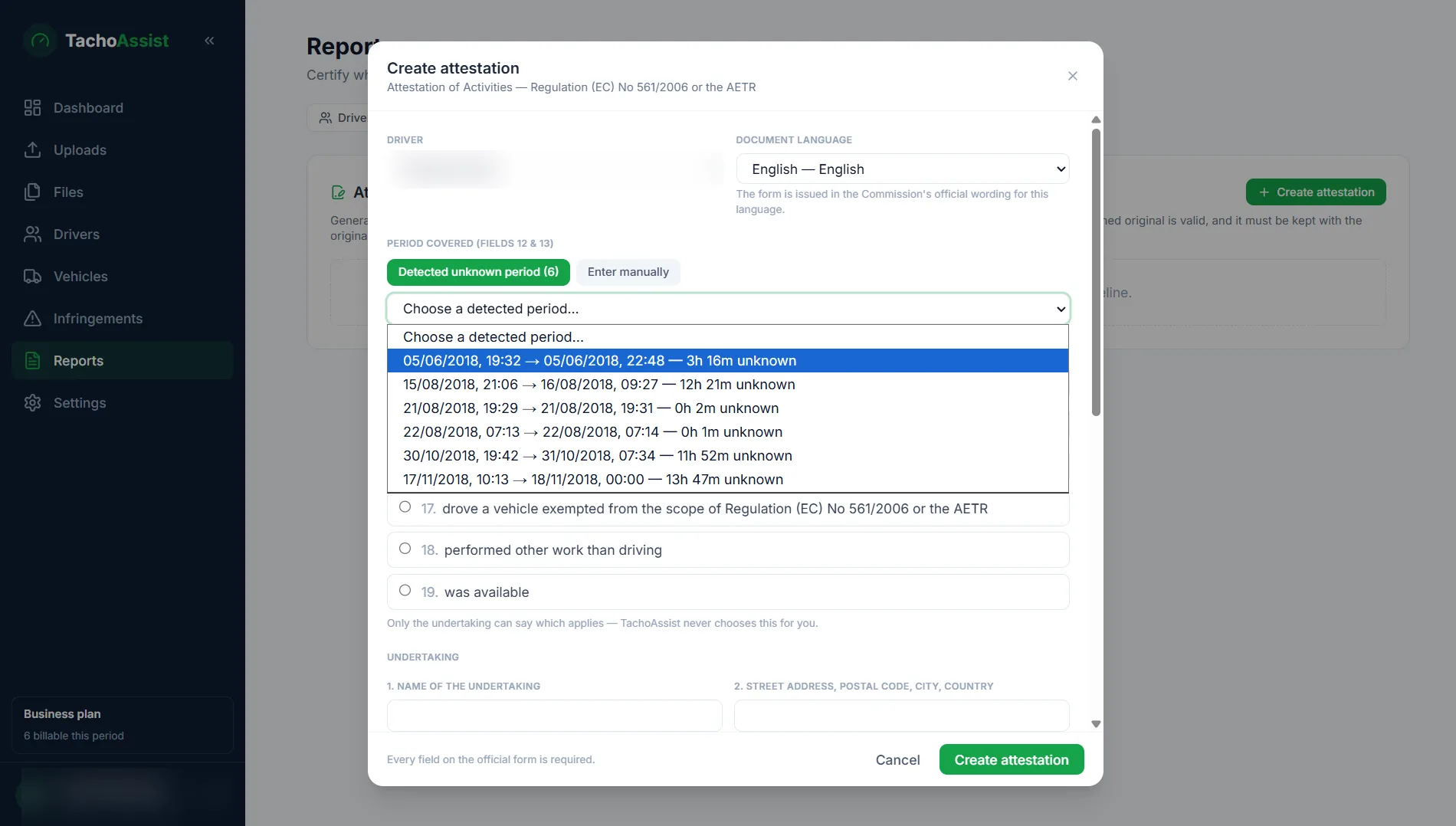
Detect unknown periods and prepare the letter of attestation.

Where a driver’s manual entries do not account for a period, TachoAssist presents the gap, lets the operator or user choose the correct activity reason, prefills the available details and generates the official EU Attestation of Activities form in any of 23 languages.

The software does not decide the legal reason, treat every gap as rest or claim that every unknown period requires a form.

How the attestation form generator works

Reminders, history and API upload.

Reminders and important dates

Card expiry dates and the time since each driver or vehicle was last downloaded sit alongside compliance and scheduled-report reminders on the dashboard.

Report and file history

Retain original uploads and generated-report history with archiving, retention and deletion controls.

API file upload

Business workspaces can use the API upload and import workflow to bring supported tachograph files into the same analysis process.

Questions

Fleet tachograph software FAQ

Which files can a Business workspace analyse?

Business supports both driver card and vehicle unit (VU) files — .ddd, .esm, .tgd, .c1b, .v1b, .a1b and .add, individually or in a ZIP — including multi-driver, fleet and vehicle reporting.

How is the Business plan billed?

It is £2.50 for each unique driver analysed during the monthly billing period — about 58p per driver per week. Vehicles and VU analysis are included and are not charged separately. Prices are in GBP and no VAT is charged, and there is no minimum term. See the full billing explanation.

Does TachoAssist work for agency drivers?

Yes. An agency driver is analysed like any other driver, and is billed only in the months their card data is actually analysed — so a driver who covers two weeks in March and nothing in April appears on the March bill only. TachoAssist analyses whatever history is on the card you are given, including work done for a previous employer.

Is TachoAssist a DVSA Earned Recognition validated supplier?

No. TachoAssist is not a DVSA Earned Recognition validated IT supplier and does not transmit KPI data to DVSA. If you are in the scheme, TachoAssist sits alongside your validated system rather than replacing it. Most operators are not in Earned Recognition, and the analysis, risk and reminder views work the same either way.

What happens when a driver is archived?

Archiving prevents future-period use from being charged unless that driver is reactivated or used again. It does not remove a charge already created by use in the current billing period.

Business: £2.50 per driver analysed — about 58p a week, no VAT charged

Start a fleet compliance workspace.

Register for a 14-day free trial. No payment card details needed to start, and no minimum term.