Hours already worked
What they did yesterday, for whom, and how much of the week is already gone. Daily and weekly driving limits, and reduced daily rests, run across employers — not across your payroll.
Agency and occasional drivers
An agency driver arrives at six, drives your vehicle on your operator licence, and is gone by teatime. The infringement is yours. The record is on a card you do not control and may never see again.
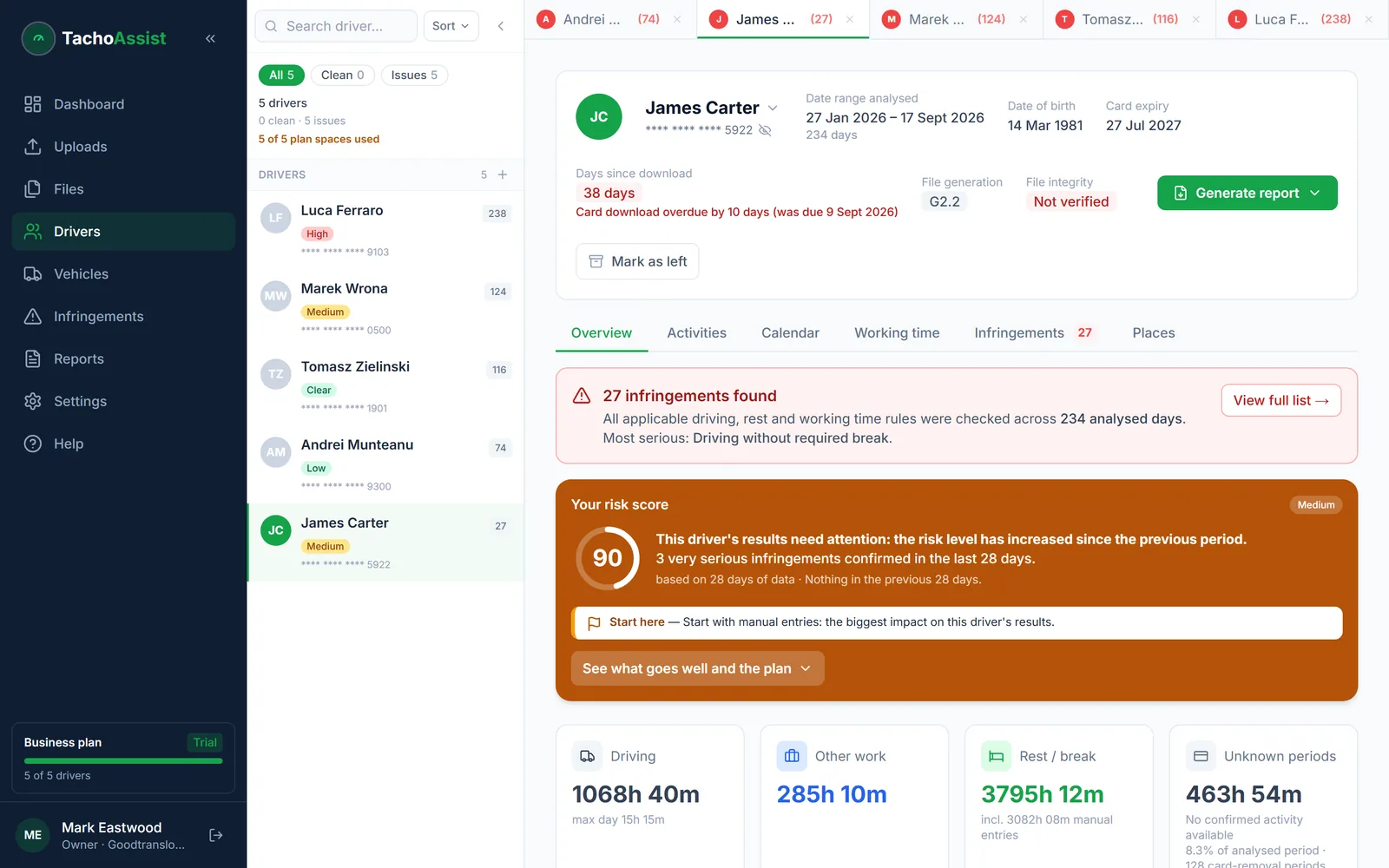
Everything about the drivers’-hours routine assumes you know the driver. You know when their card was last downloaded, what they did last week, whether their weekly rest is intact and whether the pattern you are looking at is normal for them. With an agency or occasional driver you know none of it, and the shift starts anyway.
Meanwhile the responsibility does not move. The vehicle runs on your O-licence, the vehicle unit (VU) records the movement whoever is sitting in the seat, and an examiner asking about that day’s work will ask you, not the agency. This page is a practical orientation, not legal advice — confirm the position for your own operation with the current DVSA guidance.
Four blind spots, all of which can turn a routine shift into an infringement before the vehicle leaves the yard.
What they did yesterday, for whom, and how much of the week is already gone. Daily and weekly driving limits, and reduced daily rests, run across employers — not across your payroll.
A reduced weekly rest taken at another operator still has to be compensated. From your side, the obligation is invisible until the card is downloaded and read.
Working Time (WTD) averaging runs over a reference period and across all employments. A driver can be inside your limits and outside their own.
Expired, damaged, or simply not with them. You find out at the first card-in, or, if nobody checks, when the analysis comes back a fortnight later.
The practice operators have converged on is simple and unpopular with agencies for about a fortnight: the card is downloaded before the vehicle leaves the yard and again at the end of the assignment, and the agency’s invoice is not processed until both downloads exist.
The pre-assignment download is the half most often skipped, and it is the half that protects you. It captures what the driver did before they got to you, so the shift you are about to authorise can be checked against limits that were already partly consumed. The post-assignment download is what makes your own record complete.
Put it in the booking terms rather than raising it at the gate. An agency that supplies drivers regularly will build the download into their process once it is a condition of payment.
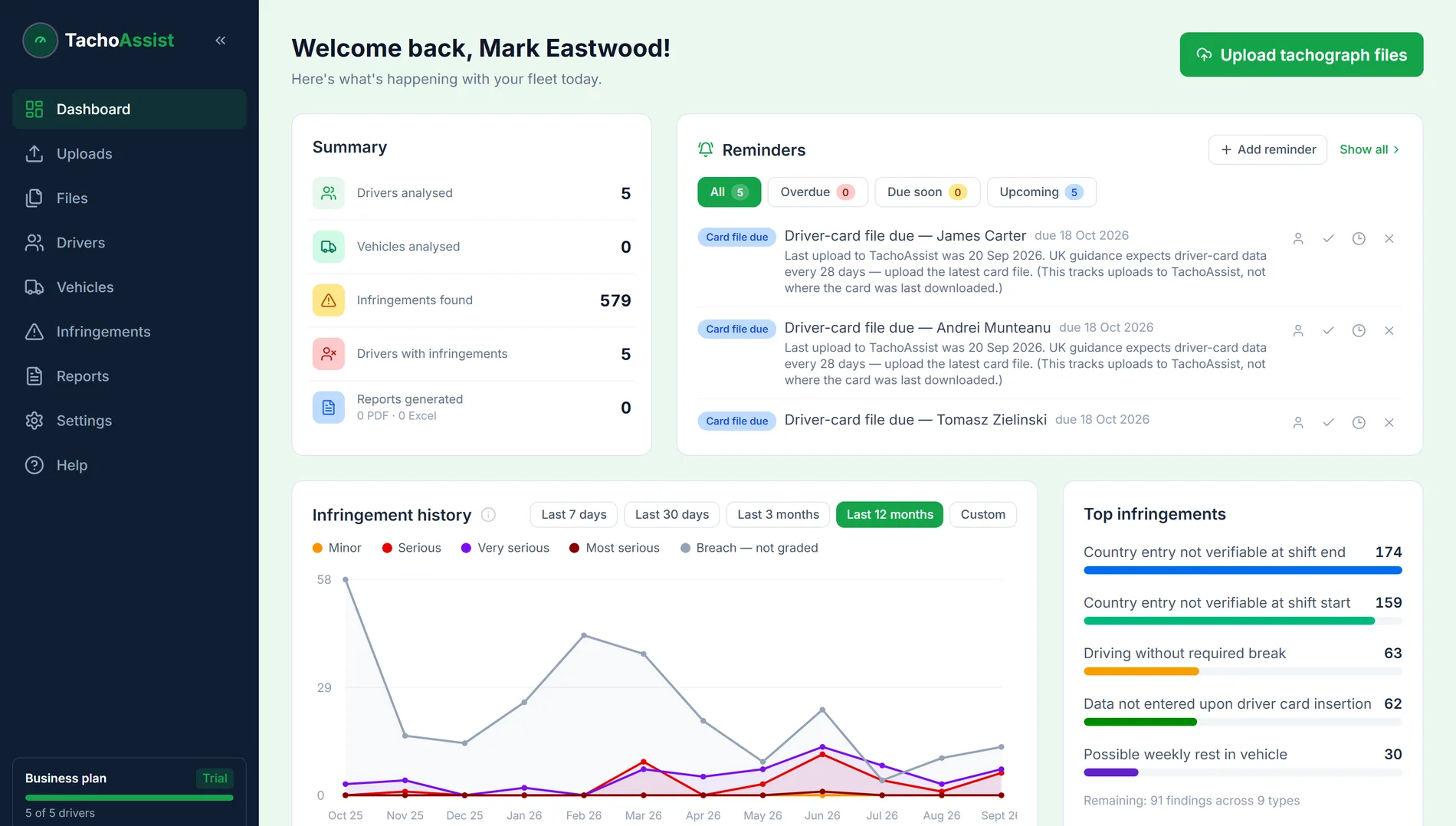
Eight things worth having written down somewhere the traffic office can see them.
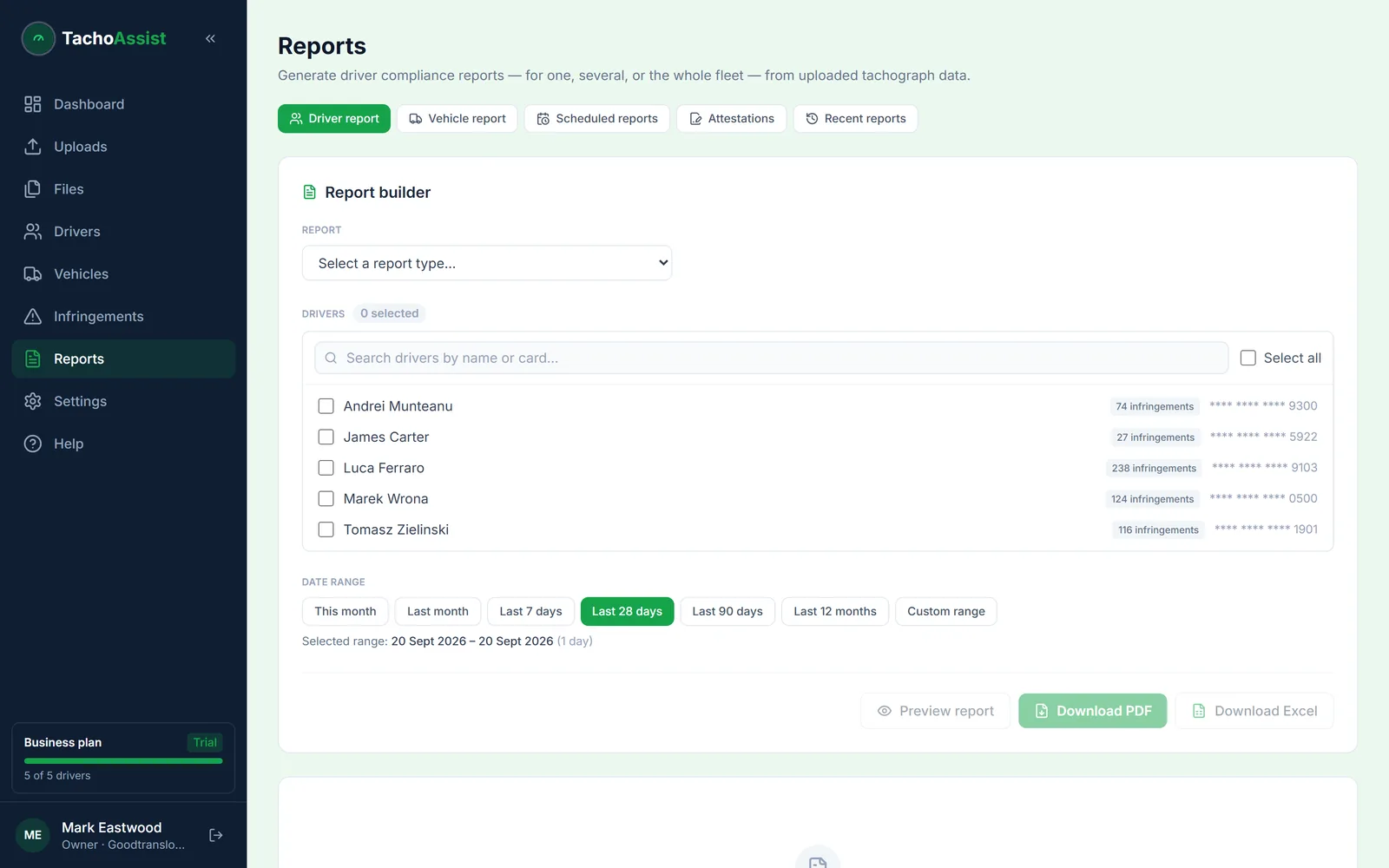
The UK convention is roughly a pound per driver per week, charged against a seat rather than against work. That model is built for a stable list of employed drivers. Apply it to a fleet that uses agency cover and you get one of two outcomes: you pay all year for a driver who did four shifts in March, or you spend your Friday afternoons archiving and re-adding people to keep the bill honest.
TachoAssist bills the other way round. On the Business plan you are charged £2.50 per unique driver analysed per month — once per driver per billing month, however many files you upload for them.
For a full-time driver that works out at roughly 58p a week. For someone who covers four shifts a year it is two pounds fifty, once. See pricing for the full detail.
Automated analysis supports an operator’s own checks and must be reviewed by a competent person. TachoAssist is not a definitive statement of compliance, and the allocation of responsibility between an operator, an agency and a driver depends on the arrangement — check the current official guidance.
Official sources
Nothing about agency work reduces the operator’s duties. These are the references behind them.
Questions
The operator whose licence the vehicle runs on carries the drivers’ hours and record-keeping responsibilities for that vehicle, and the driver has personal responsibilities as well. An agency contract does not move an operator’s licence undertakings onto the agency. Check the current DVSA guidance for the position that applies to your operation.
Make it a condition of the booking rather than a favour. Many operators run a “no download, no invoice” rule: the card is downloaded before the vehicle leaves the yard and again at the end of the assignment, and the agency’s invoice is not processed until both downloads exist.
Once the driver has gone you cannot compel a download, so the vehicle unit download becomes your record of the shift. Record the refusal in writing, raise it with the agency the same day, and treat it as a reason not to book that driver again.
On the TachoAssist Business plan each unique driver analysed is charged once in that billing month, however many files you upload for them. A driver analysed only in March is billed only in March, and a driver you never analyse is not billed at all.
Built for churn
Register and try TachoAssist for 14 days. No payment card details needed to start, and no minimum term.