Model 1
Per driver per week
The default. Usually billed in weekly increments, often a few weeks in arrears by direct debit. Watch the five-week months, and watch whether the count is drivers on the system or drivers who actually worked.
UK market pricing
Roughly a pound per driver per week is the number every UK transport manager already has in their head. Here is where that figure comes from, what the other charging models really work out at, and the questions that get you a comparable quote.
The UK tachograph analysis market has clustered around £1 per driver per week for well over a decade. Allowing 4.33 weeks in an average month, that is about £4.33 per driver per month, or a little over £50 a driver a year. On top of it, a charge of around 50p per vehicle per week for vehicle unit (VU) data is common, though some vendors include VU data at no extra cost.
The weekly framing is doing a lot of work. A pound a week sounds like nothing; forty-three pounds a month for a ten-driver fleet, plus twenty-two for the vehicles, is a real line in a small operator’s budget. Whatever else you do when comparing quotes, annualise before you decide.
Different vendors arrive at broadly similar money by four different routes. Knowing which route you are being quoted on is most of the comparison.
Model 1
The default. Usually billed in weekly increments, often a few weeks in arrears by direct debit. Watch the five-week months, and watch whether the count is drivers on the system or drivers who actually worked.
Model 2
Pre-paid annual seats, typically around £50 a driver a year, with the rate dropping as fleet size and contract length go up. Cheapest per head at scale and on multi-year terms; least forgiving if your driver list moves.
Model 3
Roughly 25–30p per driver per day worked. Vendors typically model a “driver year” at about 220 working days, which lands near the same annual figure for a full-timer — but is materially cheaper for occasional and agency drivers.
Model 4
A perpetual licence in the low hundreds of pounds with no recurring fee. Genuinely cheaper over five years for a small stable fleet — at the cost of a Windows install, local data and whatever the arrangement is for rule updates.
And separately
Someone else does the analysis and sends back the reports. Priced per driver and usually the dearest per head, often bundled with training, audit preparation or public-inquiry support — which for some operators is exactly what they are buying.
Not software
Download keys and remote-download boxes are a separate purchase from anyone, and can cost more up front than a year of analysis. Budget for them alongside the licence, not inside it. Driver cards are the cheap exception: the free TachoAssist Card Reader app turns any standard USB smart-card reader into a driver-card download tool on Windows or Android.
Most of the UK market does not publish a price. The reasons are structural rather than sinister, but the effect on a six-vehicle operator is the same either way.
The practical consequence is that the operators with the least time — owner-drivers and small fleets — get a contact form and a callback, at the exact moment they are trying to compare three options on a Sunday evening.
Ten questions that turn a headline rate into a comparable annual cost.
We publish our prices, so you can do the same arithmetic on us that this page asks you to do on everyone else.
Against the £1-per-driver-per-week convention that is roughly half the going rate — and on a mixed fleet, where the VU charge is included rather than added, the gap is wider still.
Price is one axis. Before you move on it, check that the floor of what you actually need is covered.
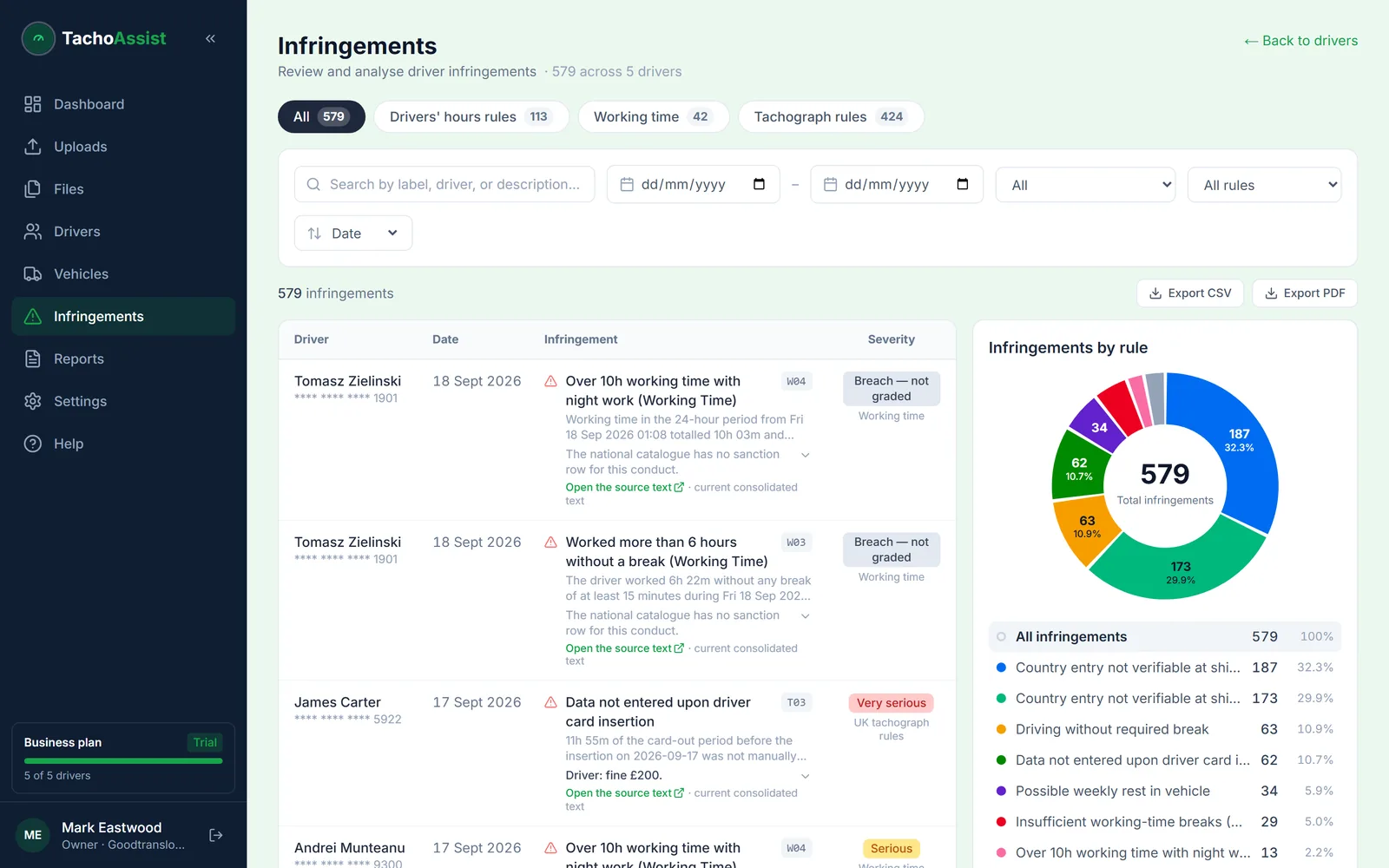
Drivers’ hours, Working Time (WTD) and tachograph infringements, each with severity, the measured values and the legal reference — not just a count.
Driver-card and vehicle unit analysis. A driver-only tool cannot show you what happened when no card was in the slot.
Reports in PDF or Excel, with file history, dated at the time the work was done — the paper trail a DVSA visit would ask for.
If you are in or joining DVSA Earned Recognition, you need a validated supplier. TachoAssist is not one, and no price makes up for that.
The rates described as market convention are a generic summary of publicly advertised UK pricing as at August 2026, given for orientation only. Vendors change prices, and quoted terms vary by fleet size and contract. Always confirm current pricing with the supplier before making a decision.
Questions
The long-standing convention is around £1 per driver per week, which is roughly £4.33 per driver per month once you allow for 4.33 weeks in an average month. Annual pre-pay plans and per-working-day plans tend to land in a similar range. A separate vehicle charge of around 50p per vehicle per week for vehicle unit data is common.
Most of the market sells through demos and quotes rather than self-service, prices are negotiated by fleet size and contract length, and tacho is often bundled into a wider O-licence compliance suite where a single per-driver figure would be misleading. The practical effect is that a small operator gets a contact form instead of a number.
Convert everything to pounds per driver per month, all in. Multiply weekly rates by 4.33, multiply daily rates by your actual working days, and add vehicle charges, analogue chart charges, setup and support fees. Then check the minimum term, what happens to the bill when a driver leaves, and whether VAT is included.
Driver is £2.00 per month and Business is £2.50 per unique driver analysed per month — roughly 46p and 58p per driver per week. Vehicles and vehicle unit analysis are included on Business at no extra cost. Prices are in GBP and no VAT is charged. There is no minimum term, and the 14-day trial does not ask for payment card details.
No callback required
Register and try TachoAssist for 14 days. No payment card details needed to start, and no minimum term.