Entry
Two years, clean
Broadly, an operator must have held an HGV or PSV licence for at least two years with no regulatory action beyond formal warnings in that period, and must use validated IT for both maintenance and drivers’ hours.
Earned Recognition
Shorter download intervals, analysis within a week, debriefs within a month and a KPI submission every four weeks. Here is the cadence in full — and why it is worth borrowing even if you never join the scheme.
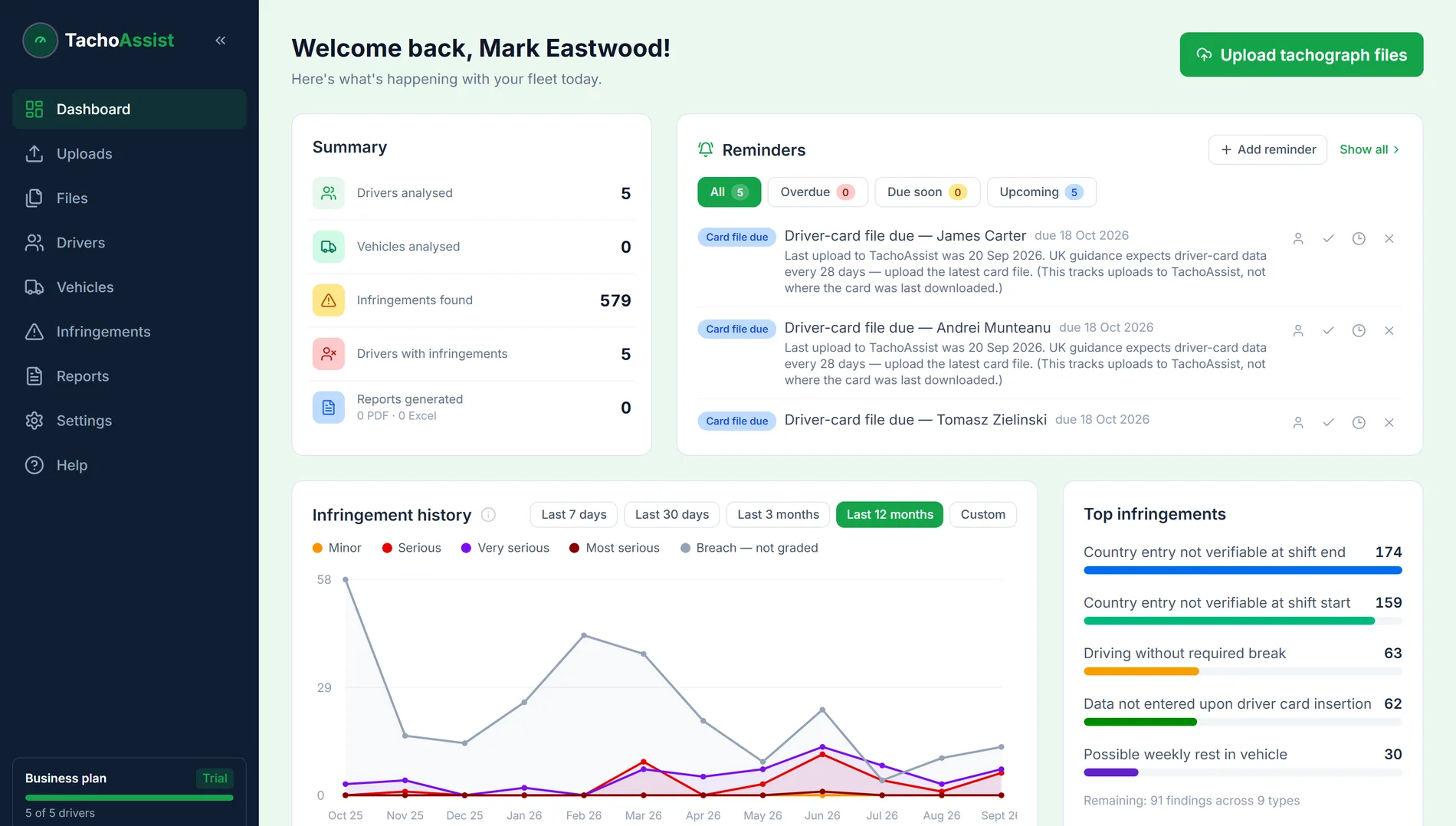
TachoAssist is not a DVSA Earned Recognition validated IT supplier. Earned Recognition requires validated software on both the vehicle-maintenance and the drivers’-hours side, and only a validated supplier can transmit KPI results to DVSA on the four-weekly cycle. If you are in the scheme, or applying to join, you need a supplier from the validated list. We will not pretend otherwise.
This page exists because the great majority of UK operators are not in Earned Recognition and never will be — and the standard the scheme sets is still the clearest published description of what a well-run drivers’-hours routine looks like. You can run to that standard without joining anything.
A voluntary DVSA scheme in which an operator proves ongoing compliance through data, rather than waiting to be inspected reactively.
Entry
Broadly, an operator must have held an HGV or PSV licence for at least two years with no regulatory action beyond formal warnings in that period, and must use validated IT for both maintenance and drivers’ hours.
Ongoing
The validated system transmits KPI results to DVSA on a four-weekly cycle. The operator is also audited every two years by a DVSA-authorised audit provider, at the operator’s own cost.
Benefit
Members are shown in a separate blue band and are listed on GOV.UK. In practice the attraction is a reduced likelihood of roadside stops and premises visits — the enforcement attention goes elsewhere.
These are the timing requirements set out in the DVSA HGV operator audit standards. Note how each one is tighter than the general legal position, and how they chain together into a routine rather than sitting as separate rules.
On the numerical thresholds: the scheme also sets percentage limits for the KPIs themselves. We do not reproduce those figures here, because they are the part most often quoted out of date on third-party sites. Read them from the current GOV.UK publication linked below.
Six habits from the audit standards that need no validation, no audit fee and no application.
Work to 14 days on the cards and 42 on the units instead of 28 and 90. A fortnightly rhythm is easier to hold than a monthly one, and it halves how stale the worst infringement can be.
A download sitting unanalysed is not evidence of anything. Getting files analysed within seven days is what turns a download policy into a compliance system.
Late debriefs are the most common failure. A driver cannot usefully account for a shift they cannot remember, and a Traffic Commissioner will notice the interval.
Classify every infringement the same way each time — minor, serious, very serious, most serious — so repeat patterns surface instead of averaging out.
12 months for tachograph records and 24 for Working Time (WTD) records are different obligations with different end dates. Treating them as one number loses you the second year.
Track your own infringement rate over time. You do not need DVSA’s thresholds to know whether last quarter was better than the one before it.
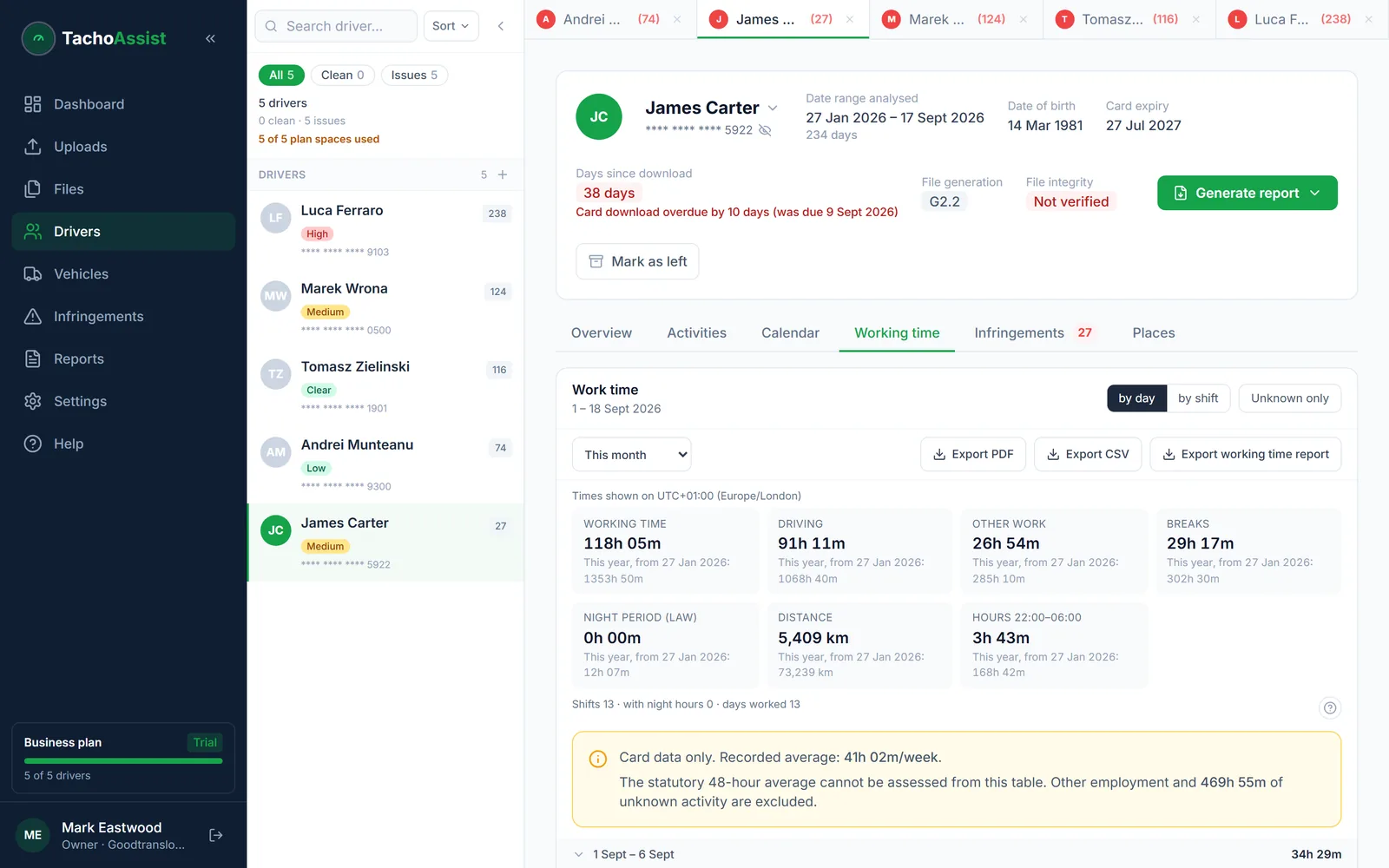
TachoAssist is the analysis workspace, not an Earned Recognition pathway. It is worth being precise about which parts of the cadence it can support.
What it does not do: transmit KPI data to DVSA, provide a validated ER submission, or provide a driver sign-off workflow. Those are scheme mechanics, and they need a validated supplier.
TachoAssist is not a DVSA Earned Recognition validated IT supplier and cannot be used to meet the scheme’s KPI submission requirement. Automated analysis supports an operator’s own checks and must be reviewed by a competent person; it is not legal advice or a definitive statement of compliance.
Official sources
Scheme requirements and thresholds are updated by DVSA. Take the figures from the current publication rather than a summary.
Questions
No. TachoAssist is not validated under DVSA Earned Recognition and does not transmit KPI data to DVSA. An operator in the scheme, or applying to join it, needs software from the validated supplier list for both drivers’ hours and vehicle maintenance.
The DVSA HGV operator audit standards require driver card data to be downloaded and submitted for analysis at least every 14 days. The general legal maximum outside the scheme is 28 days, so Earned Recognition roughly halves it.
The audit standards require drivers to be debriefed within 28 days of the infringement, with all records submitted for analysis within 7 days of download.
No. The cadence is a set of operating habits, not a licence condition. Most UK operators will never join the scheme, and can still download more often than the law requires, analyse within days and debrief inside a month. Only the KPI transmission and the audit require scheme membership and a validated supplier.