Inputs
Enforcement encounters
The traffic score is weighted across DVSA enforcement encounters — roadside checks and the outcomes recorded against them. Drivers’ hours and tachograph offences, fixed penalties and overloading all feed in.
Operator Compliance Risk Score
Drivers’ hours and tachograph offences are one of the main inputs to the DVSA traffic score. The score is calculated over three rolling years, it is banded in colours, and it is a large part of the answer to why one operator gets pulled in and another does not.
OCRS is the DVSA Operator Compliance Risk Score. Every operator licence carries three of them: a roadworthiness score, a traffic score, and a combined score. Roadworthiness comes from the vehicle side — annual test results, roadside inspections, defects and prohibitions. Traffic comes from the conduct side, and drivers’ hours and tachograph offences sit squarely in it, alongside things like overloading and fixed penalties issued at the roadside.
It is worth being clear about what the score is not. It is not a rating of your paperwork, your analysis software or your intentions. It is a summary of what DVSA has actually encountered when it met your vehicles and your drivers. This page is an orientation for transport managers; check the current DVSA guidance for the definitive position.
Three characteristics matter more than the arithmetic: what counts, how long it counts for, and how the result is presented.
Inputs
The traffic score is weighted across DVSA enforcement encounters — roadside checks and the outcomes recorded against them. Drivers’ hours and tachograph offences, fixed penalties and overloading all feed in.
Window
Data is weighted across the previous three years. Encounters age out as the window rolls forward, which is why a damaged score recovers gradually rather than the week after you fix the cause.
Output
Scores are presented in bands. Operators in DVSA Earned Recognition are shown in a separate blue band. Operators talk about their score in those colours, not in points.
DVSA cannot check every vehicle, so it targets. OCRS is one of the tools that decides where the resource goes. A green band means your vehicles are statistically less interesting at the roadside; a red band means the opposite, and it also makes a visit to your premises more likely.
That is the practical loop most operators miss. An infringement is not a self-contained event with a fixed cost. It creates an encounter, the encounter feeds the traffic score, the score attracts more encounters, and more encounters find more of whatever was wrong in the first place.
Almost nobody in this chain is looking at a single day’s driving. They are looking for whether the operator had a system.
Three different classification systems get confused with one another in day-to-day conversation. They do different jobs.
Minor, serious, very serious and most serious infringement. The severity categories used to classify a drivers’ hours or tachograph breach, mirroring the assimilated Regulation (EU) 2016/403 categories. Serious and above are reportable to the relevant register.
The roadside sanction ladder DVSA applies, graduated by the size of the breach, running through prohibition and immobilisation to a report to the Traffic Commissioner. A separate scheme with its own bands.
Red, amber and green — blue for Earned Recognition members. A summary of encounter history, not a classification of any individual breach.
You cannot edit an OCRS score, appeal a band or offset it with good paperwork. The only lever is the rate at which your operation generates enforcement outcomes — and that is decided in the yard, weeks before anyone gets stopped.
The loop examiners look for is the same one a Traffic Commissioner asks about: did the operator spot the infringement, grade it properly, debrief the driver, record the corrective action, and then go back and check the behaviour changed. An operator who can show that loop running is in a different position from one who can only show that infringements existed.
The honest version of the product claim.
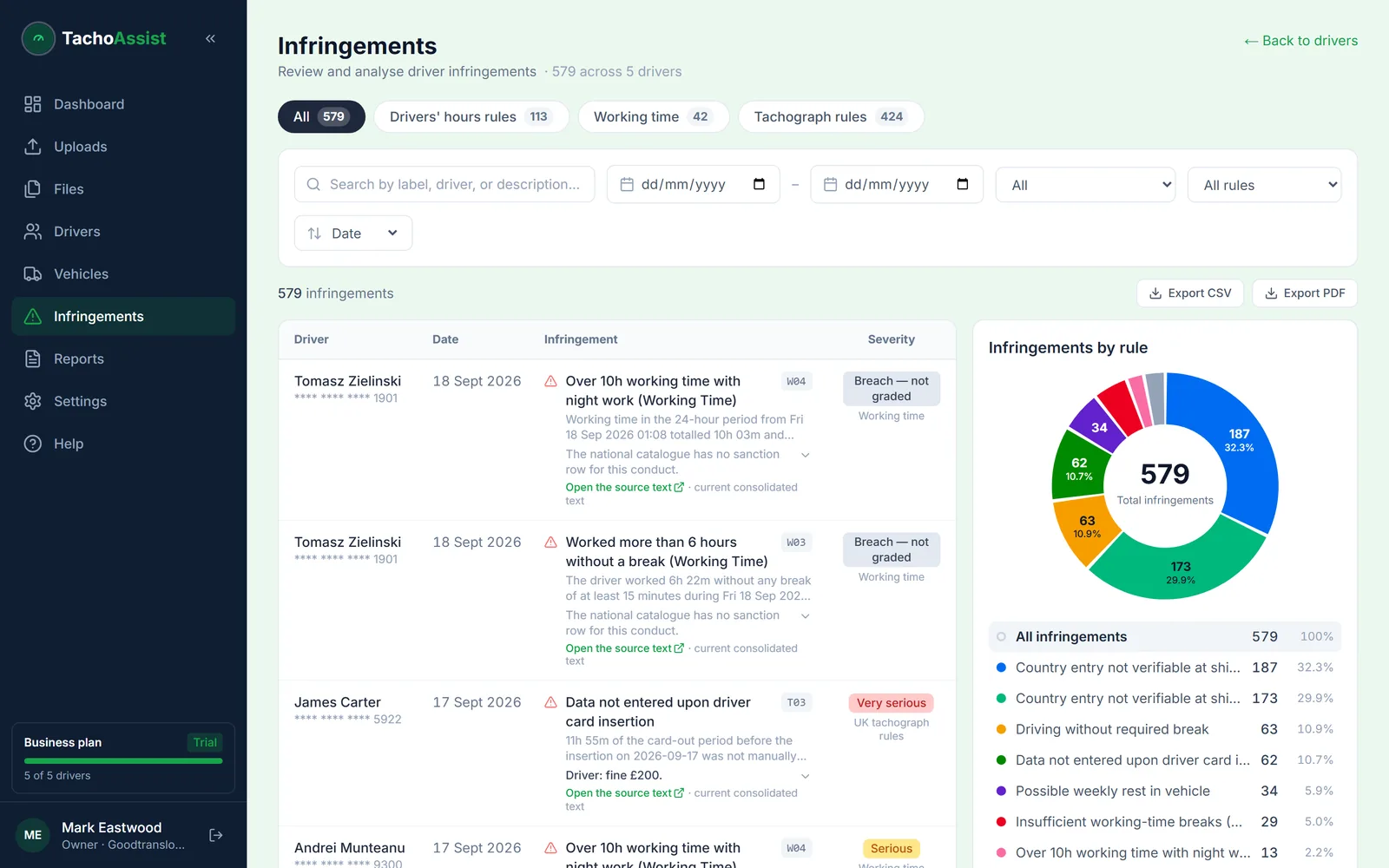
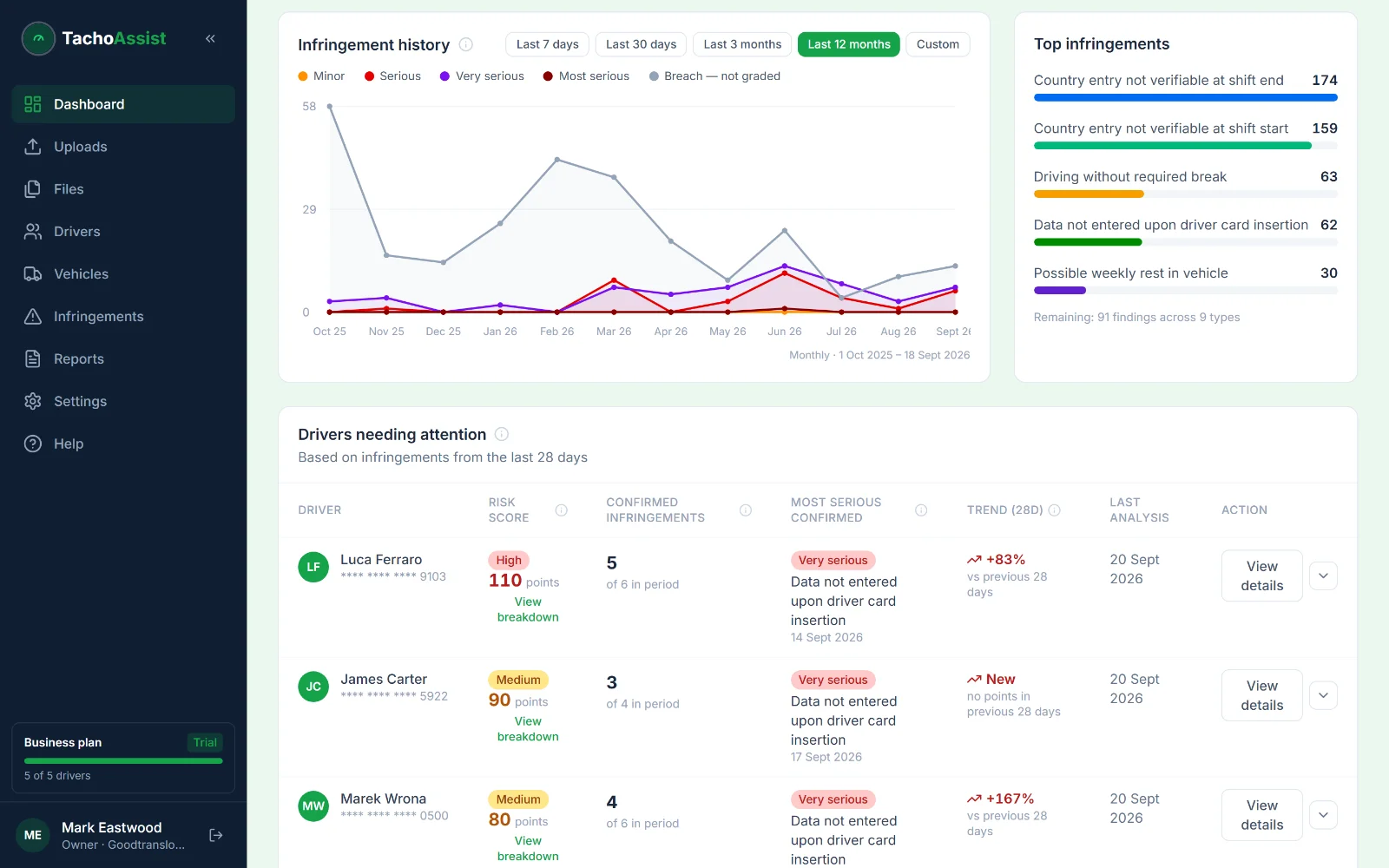
Each infringement arrives with its severity, the measured values, a plain-English explanation and the legal reference, so it can be graded and discussed rather than just counted.
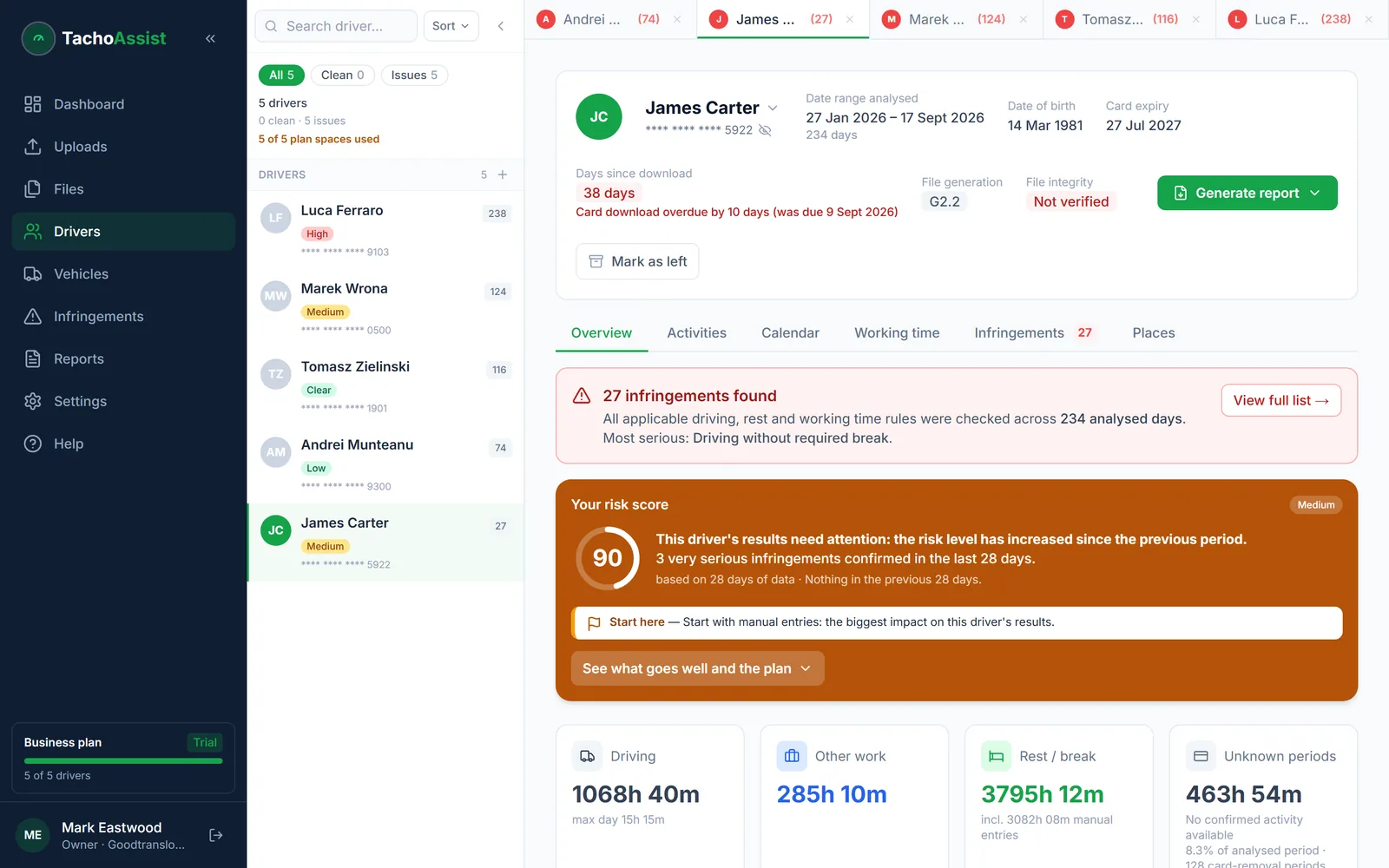
TachoAssist calculates its own internal risk score per driver so the drivers to debrief first are visible. It is an internal indicator only — it is not OCRS, and it is not an authority rating.
Driver, fleet and vehicle reports in PDF or Excel, plus file history, give you a paper trail dated at the time the work was done.
OCRS is calculated by DVSA from its own enforcement data. TachoAssist does not read it, predict it or influence it, and automated analysis results must be reviewed by a competent person. Nothing here is legal advice or a definitive statement of compliance.
Official sources
The band definitions and the calculation change from time to time. Use the primary sources.
Questions
OCRS is the DVSA Operator Compliance Risk Score. Every operator licence carries a roadworthiness score, a traffic score and a combined score, built from DVSA’s record of enforcement encounters and presented in bands. DVSA uses it to decide where to direct roadside and premises attention.
OCRS is calculated over a three-year rolling window. Encounters drop out of the calculation as they age past three years, which is why a score improves slowly rather than immediately after the underlying problem is fixed.
No. OCRS is built from DVSA’s own enforcement encounters, not from an operator’s in-house analysis. Finding and dealing with an infringement yourself keeps it out of the score; leaving the behaviour uncorrected is what eventually produces the encounter that does count.
No. OCRS belongs to DVSA and is calculated from its own enforcement data. TachoAssist has no access to it and does not predict it. You can check your own score through the OCRS service on GOV.UK.