No hours behind it
Driving nobody has to justify
Distance driven with the card out carries no driving time, no break and no rest against it. If that time belongs to a shift, the shift as recorded is not the shift as driven.
UK compliance explainer
Unaccounted mileage is the gap between what a vehicle did and what any driver card can account for. Most of it is innocent. The point of looking is to be able to prove which is which.
Missing mileage — British transport offices say mileage, never kilometres — is distance a vehicle has covered that no driver card accounts for. The odometer reading at the end of one recorded period does not match the reading at the start of the next, so somewhere in between the vehicle moved with no card in the slot, or moved with the distance recorded against nobody.
It is a reconciliation between two sides of the same record: the vehicle unit (VU), which knows how far the vehicle went and when a card was inserted or withdrawn, and the driver card, which knows what a named person was doing. Where the two disagree, you have a question to answer. This page explains the question; it is an orientation for transport managers, not legal advice.
Unaccounted mileage is not an offence in its own right. It is an indicator, and it points at the things enforcement is actually interested in.
No hours behind it
Distance driven with the card out carries no driving time, no break and no rest against it. If that time belongs to a shift, the shift as recorded is not the shift as driven.
A concealment marker
Card-out running at the end of a shift is one of the recognised markers of a driver working past a limit, doing unrecorded work elsewhere, or a card being used by the wrong person.
Your undertakings
An operator licence carries the undertaking that the rules on drivers’ hours and tachographs are observed, and proper records are kept. Mileage nobody can explain goes straight to that promise.
Most missing mileage in a well-run fleet is entirely legitimate. Someone who is not the driver moved the vehicle, or the driver moved it in circumstances where the card was never going to be in the slot.
None of this is a problem. It becomes a problem when it happens and nobody wrote down why.
Four characteristics separate a shunt across a yard from something an examiner would call systematic.
A few hundred yards around a yard is a shunt. Tens or hundreds of miles is a journey, and a journey needs a driver, a break pattern and a rest period.
The same driver, the same shift end, week after week. One-off gaps are noise. A pattern attached to one person is a pattern.
Unaccounted mileage that spans the end of a working day, or that moves the vehicle between two depots, is difficult to explain as yard movement.
Missing mileage alongside missing days on the same driver’s card, or alongside driving without a valid card, is a different conversation from an isolated workshop move.
You cannot stop vehicles being moved without a card. You can make sure every such movement has a written reason attached to it within days rather than months.
Under DVSA Earned Recognition this discipline is formalised into a much shorter cadence. Operators outside the scheme benefit from the same habits.
Being straight about this matters more than a feature list.
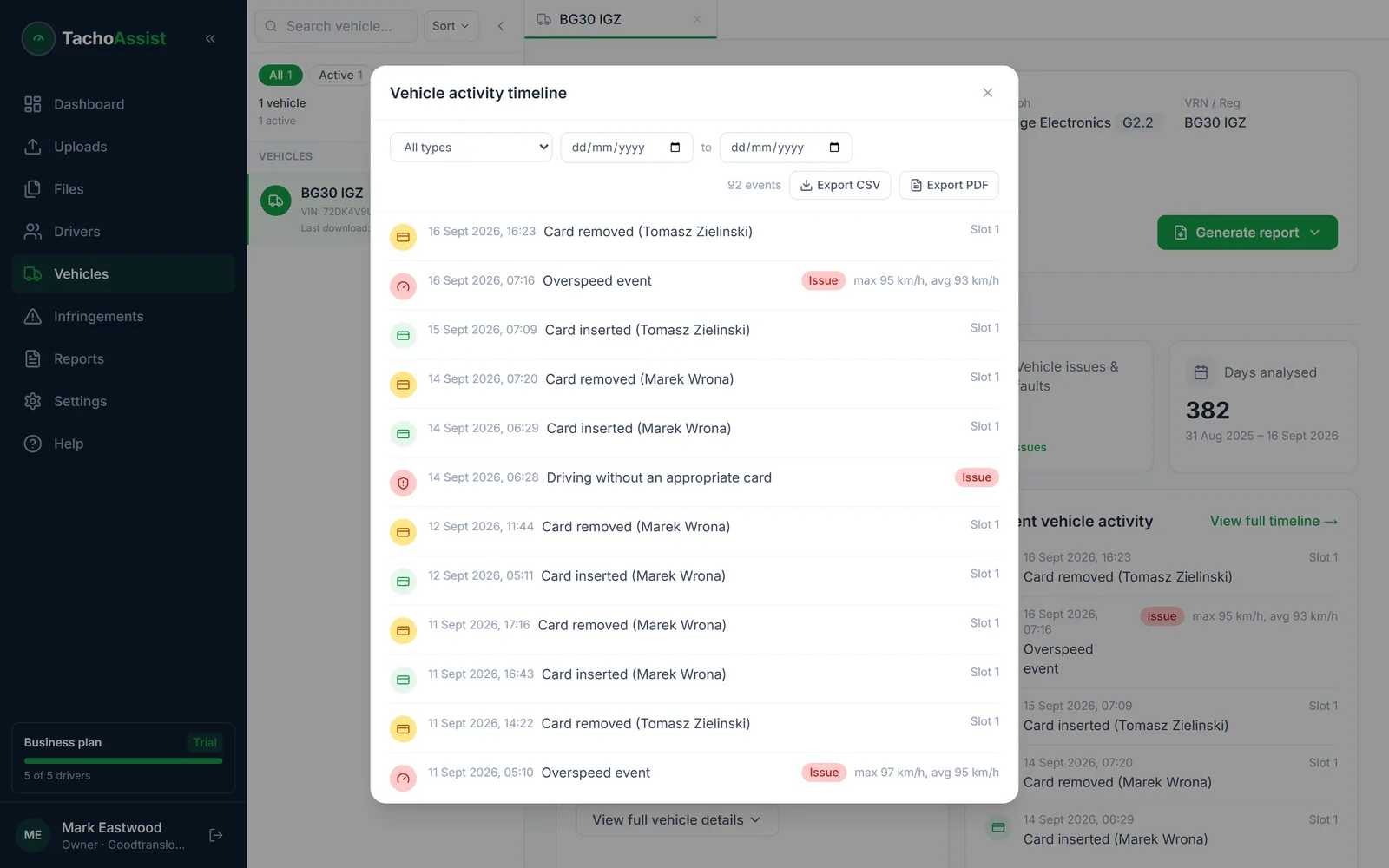
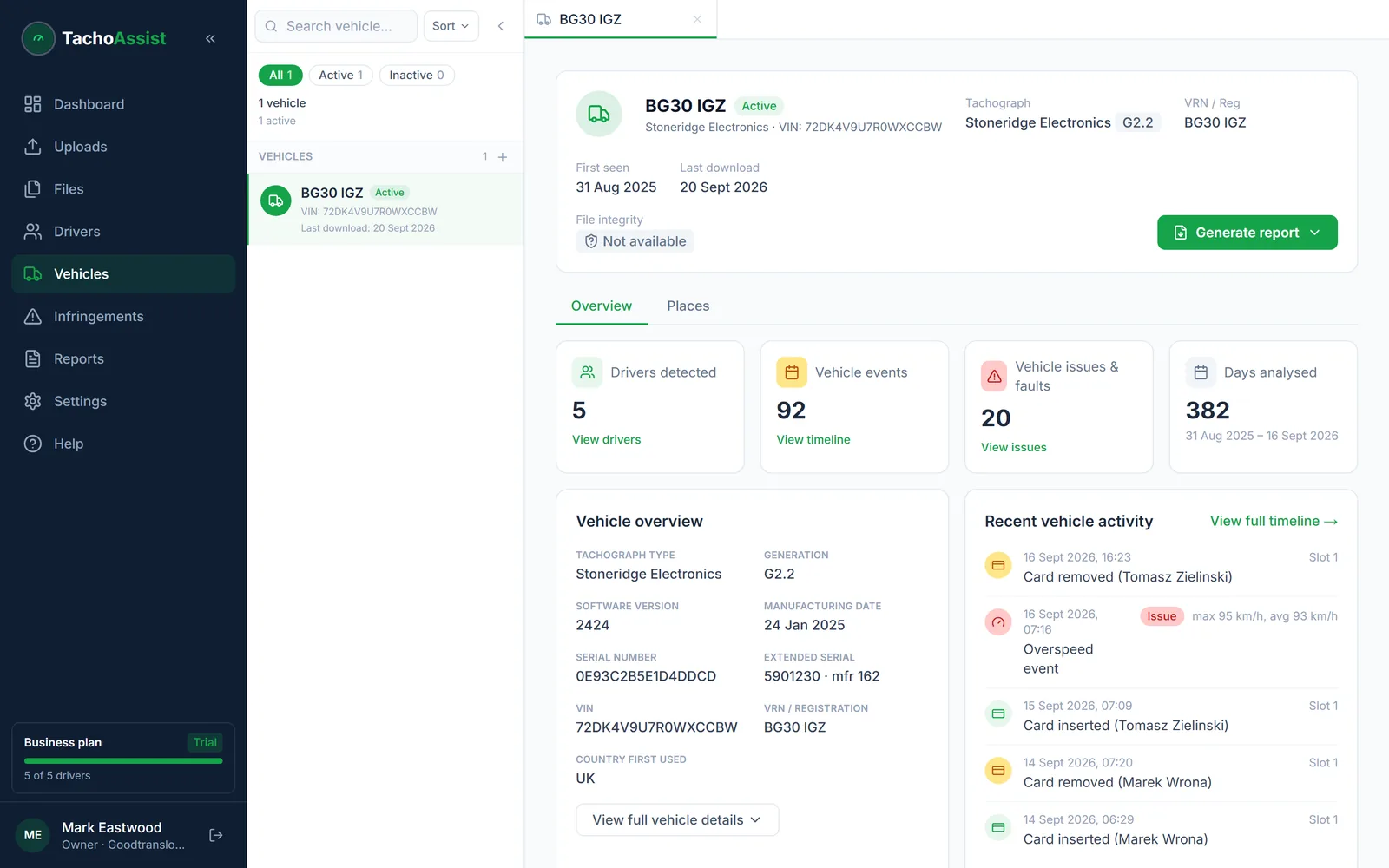
Vehicle unit analysis on the Business plan shows detected driver cards, card insertion and withdrawal records, tachograph events and faults, power interruptions and download history in date order.
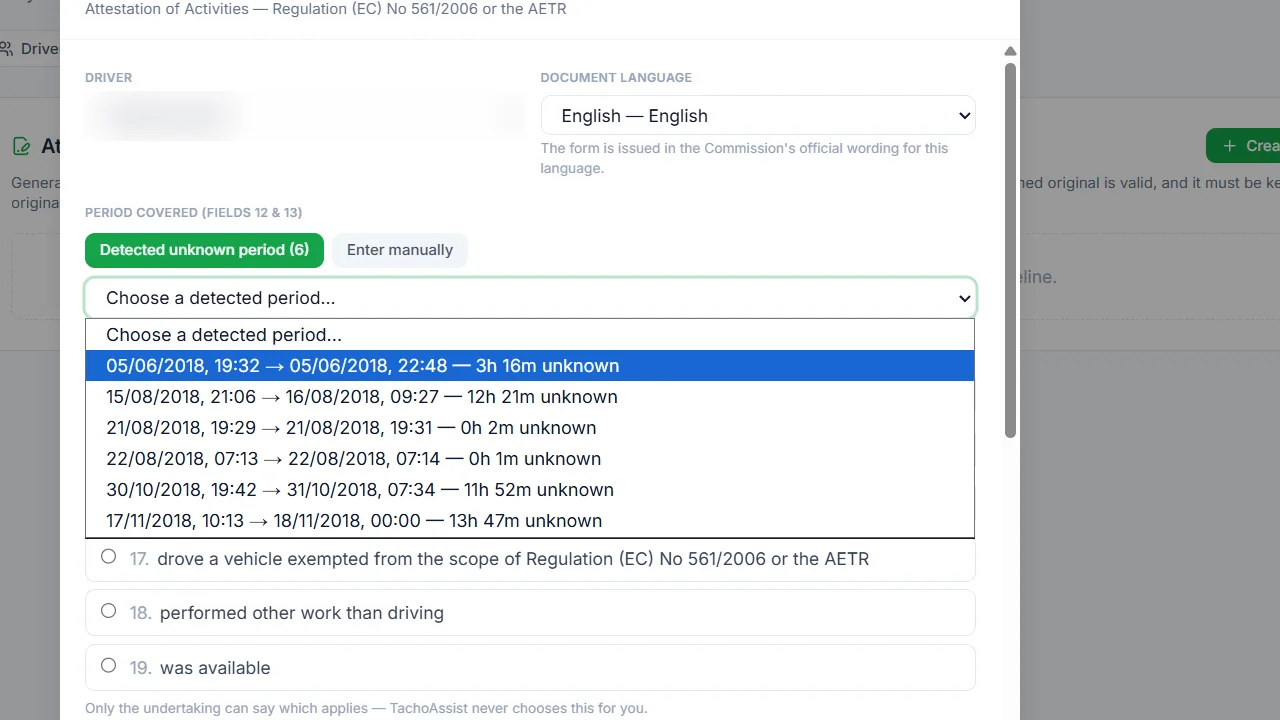
Unknown periods on a driver card are detected automatically, and the official EU attestation form can be produced for periods the card cannot cover.
There is no missing mileage report in TachoAssist. Reconciling odometer readings between records is work the operator does; what the software provides is a clear view of when a card was and was not in the slot.
Automated analysis supports an operator’s own checks and must be reviewed by a competent person. TachoAssist is not a definitive statement of compliance, and nothing here replaces the current official guidance for the vehicle, journey and worker concerned.
Official sources
Guidance changes. These are the primary references behind the obligations described above.
Questions
Missing mileage is distance a vehicle has covered that no driver card accounts for. The odometer reading at the end of one recorded period does not match the reading at the start of the next, so the vehicle moved with no card in the slot or with the movement recorded against nobody.
No. Workshop moves, yard shunting, valeting, fuelling and recovery all produce genuine unaccounted mileage. What matters is whether the operator can show why the movement happened. Unexplained mileage, repeated against the same driver or covering real distance, is the kind an examiner will take seriously.
By comparing the vehicle side of the record with the driver side. The vehicle unit records odometer values, card insertions and withdrawals and driving without a valid card, so a movement with no card in the slot leaves a trace on the vehicle even when nothing appears on any driver card.
No. TachoAssist does not have a missing mileage report. Vehicle unit analysis on the Business plan shows detected driver cards, card insertion and withdrawal records, events and faults in date order, and unknown periods are detected on the driver side, but reconciling odometer readings is work the operator still does.