Driver card download
Every 28 days
Download the cards at least every 28 days. The duty sits in s.97E of the Transport Act 1968, inserted by SI 2008/198, and is repeated in DVSA guidance.
UK operator reference
Four different periods get confused with each other constantly — the card download interval, the vehicle unit (VU) interval, how many days of records a driver carries at the roadside, and how long you keep everything afterwards. Each is set out below with the legislation behind it.
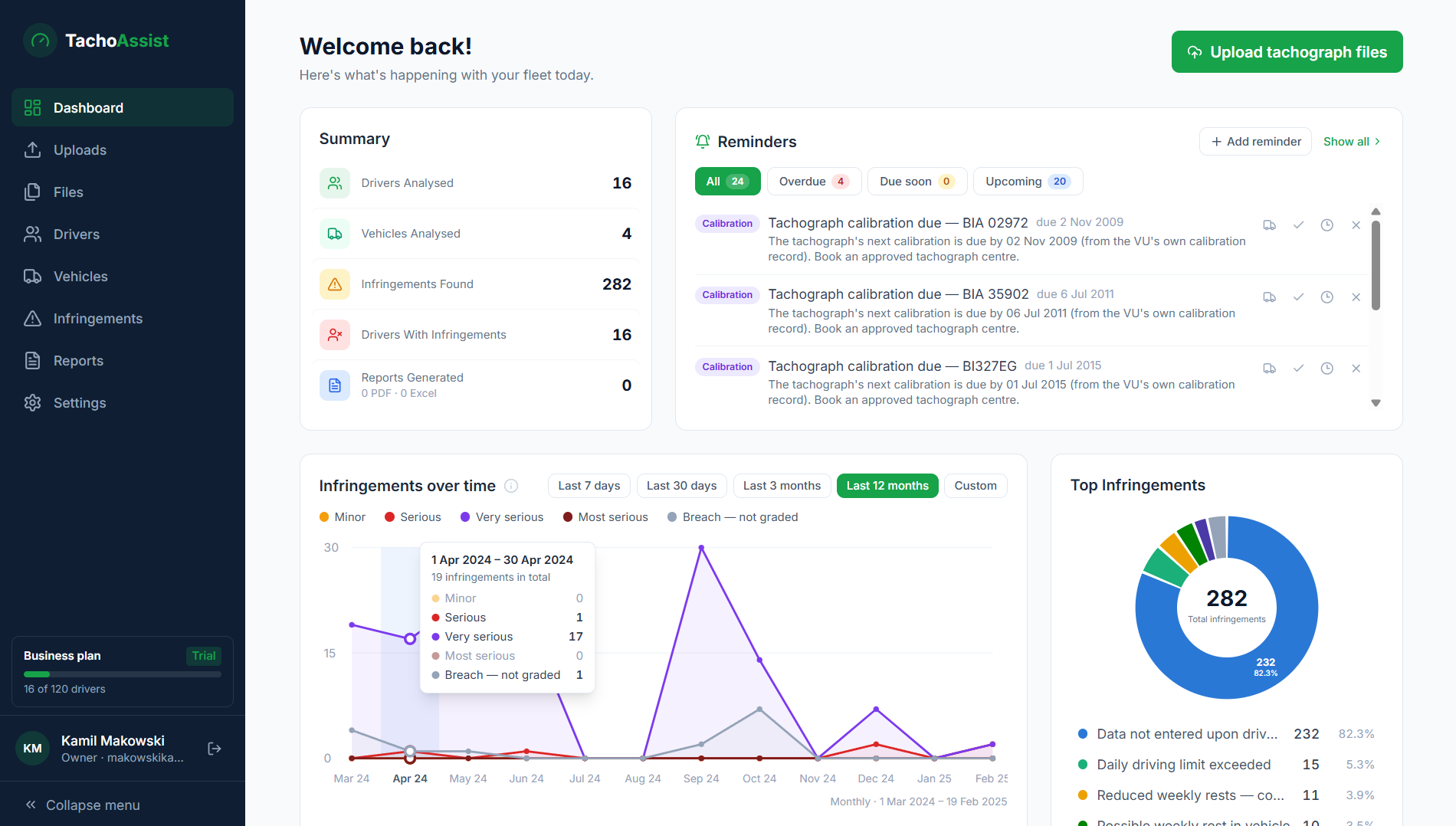
Download intervals, roadside carry periods and retention periods are three different things, governed by three different provisions. The figures below reflect DVSA guidance and the legislation for Great Britain, last checked on 27 August 2026.
This is a practical orientation, not legal advice. Always confirm which rules apply to the vehicle, journey and worker using the linked official sources.
Driver card download
Download the cards at least every 28 days. The duty sits in s.97E of the Transport Act 1968, inserted by SI 2008/198, and is repeated in DVSA guidance.
Vehicle unit download
Download the units at least every 90 calendar days, and sooner in the circumstances listed further down. Not 56 — that figure changed in 2015.
Carried at the roadside
The current day plus the previous 28 calendar days for GB domestic and AETR work; 56 days for UK–EU work only, since 21 April 2025.
Retention
Tachograph records must be available for at least 12 months. Working Time (WTD) records are kept for two years after the period they cover.
The 28-versus-56 question
This is the single most confused figure in UK tachograph compliance, and since April 2025 the honest answer is that it depends on the journey.
GB domestic and AETR work: 28 days. DVSA guidance is unchanged — the driver produces the current day plus the previous 28 calendar days, together with the card, on request.
UK–EU work: 56 days. The Drivers’ Hours and Tachographs (Amendment and Modification) Regulations 2025 (SI 2025/402) came into force on 21 April 2025. They insert a new Article 2(2A) into assimilated Regulation (EC) 561/2006 and modify Article 36 of assimilated Regulation (EU) 165/2014, so that the 56-day period applies to carriage undertaken exclusively within the UK and EU area by UK- or EU-registered vehicles. This implements the record-keeping provision of the Trade and Cooperation Agreement.
Great Britain did not simply move everything to 56. That is where most summaries go wrong. Purely GB-domestic work, and AETR work outside the UK–EU area, stay on 28 days. A vehicle that does both in the same period is, in practice, planning around the longer one.
A stale figure worth knowing about
When the Passenger and Goods Vehicles (Recording Equipment) (Downloading and Retention of Data) Regulations 2008 were made, they inserted s.97D of the Transport Act 1968 with a 56-day maximum interval for downloading a vehicle unit. That is the version of the text still sitting on plenty of third-party pages, blog posts and downloaded PDFs.
It was superseded. The Passenger and Goods Vehicles (Recording Equipment) (Downloading of Data) Regulations 2015 amended s.97D to 90 days, aligning Great Britain with Commission Regulation (EU) 581/2010. DVSA guidance has said 90 ever since.
The practical consequence is small but worth stating: a fleet working to 56-day VU downloads is being stricter than the law requires, which is harmless; a fleet that reads “56” on a stale page, assumes the other figures on it are equally current, and applies 56 days to the card is not. Cards are 28.
DVSA guidance says operators must download data from digital and smart tachographs and driver cards, and analyse the information to ensure that the rules have been complied with. A download key full of untouched files does not discharge that duty, and a Traffic Commissioner will ask what happened after the download, not before it.
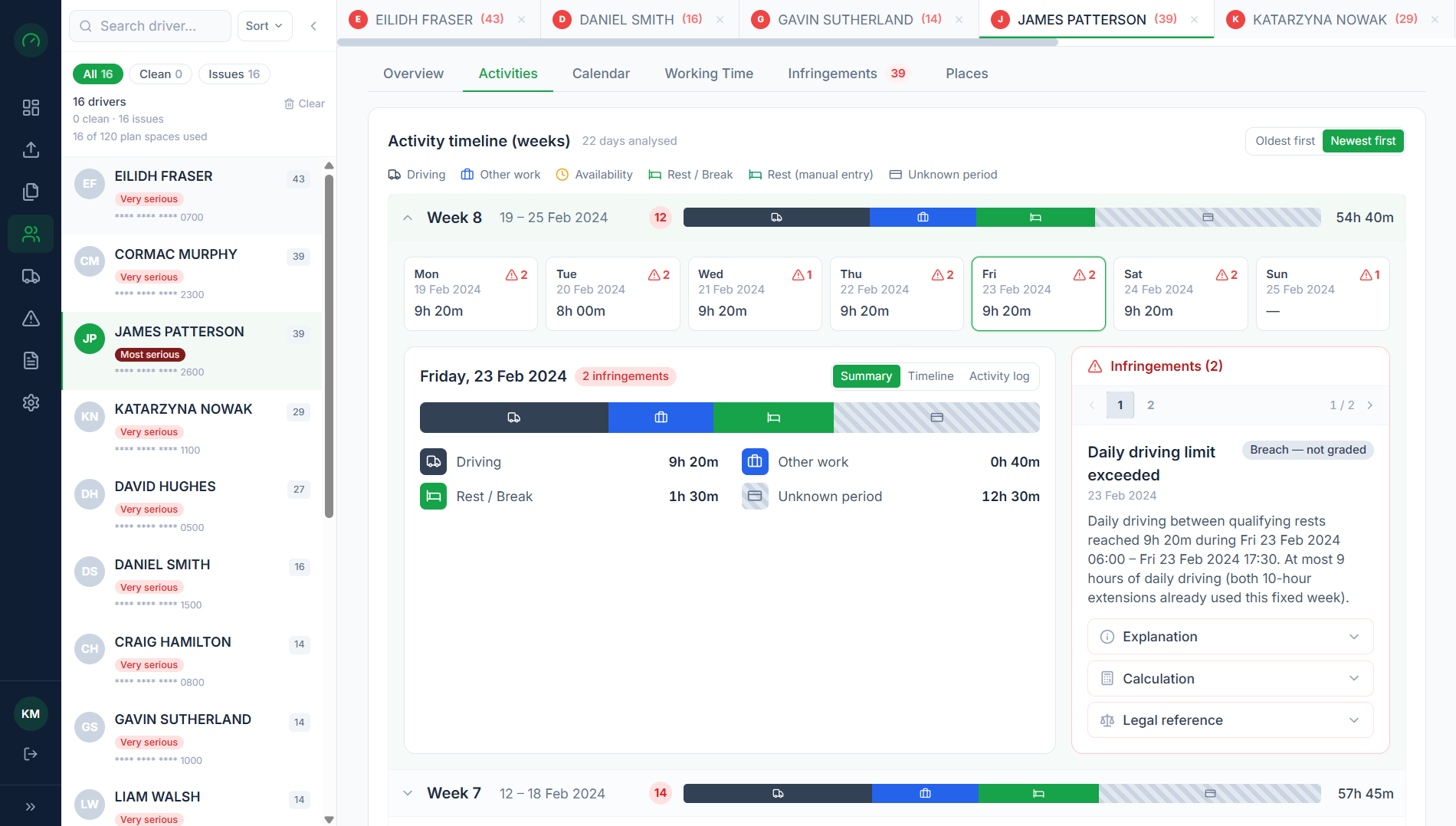
The 90-day interval is a maximum routine interval, not a reason to wait where data is at risk or control of the vehicle is changing.
DVSA guidance requires a download immediately before transferring control of the vehicle, including sale or un-hire.
Download without delay when permanently removing the unit or, where possible, after becoming aware that it is malfunctioning.
Download without delay where data may be erased imminently, and as often as necessary to ensure no data is lost.
Common misconceptions
Not since 2015. The interval is 90 days. The 56-day figure is the 2008 regulations as originally made, and it has been amended.
Journey-dependent since 21 April 2025. GB domestic and AETR work is 28 days; work carried out exclusively within the UK–EU area is 56.
Not under the assimilated rules. There is no opt-out from the 48-hour average for mobile workers under the Road Transport (Working Time) Regulations 2005. Only drivers working solely under GB domestic rules, who fall under the Working Time Regulations 1998, have an opt-out available.
The requirement is to download and analyse. Files that are archived but never reviewed satisfy neither the guidance nor the licence undertaking that proper records are kept.
A stricter cadence than the law
Earned Recognition (ER) sets its own drivers’-hours cadence, and it is tighter than the statutory minimum in every direction.
Under the scheme’s HGV operator audit standards, driver card data is downloaded and submitted for analysis at least every 14 days rather than 28, and vehicle unit data at least every 42 days rather than 90. Records go for analysis within days of download rather than whenever the office gets to them, and drivers are debriefed within 28 days of the infringement. Retention still runs 12 months for tachograph records and two years for WTD.
The reward is a blue OCRS band and materially fewer roadside stops. The cost is an operating rhythm that has to be genuinely maintained, with KPI data submitted to DVSA every four weeks using approved software.
Being straight about this: TachoAssist is not a DVSA Earned Recognition validated supplier and does not claim to be. If ER is your route, check the current audit standards and the approved-supplier position on gov.uk before committing — the thresholds are reviewed and this page is not the authority on them.
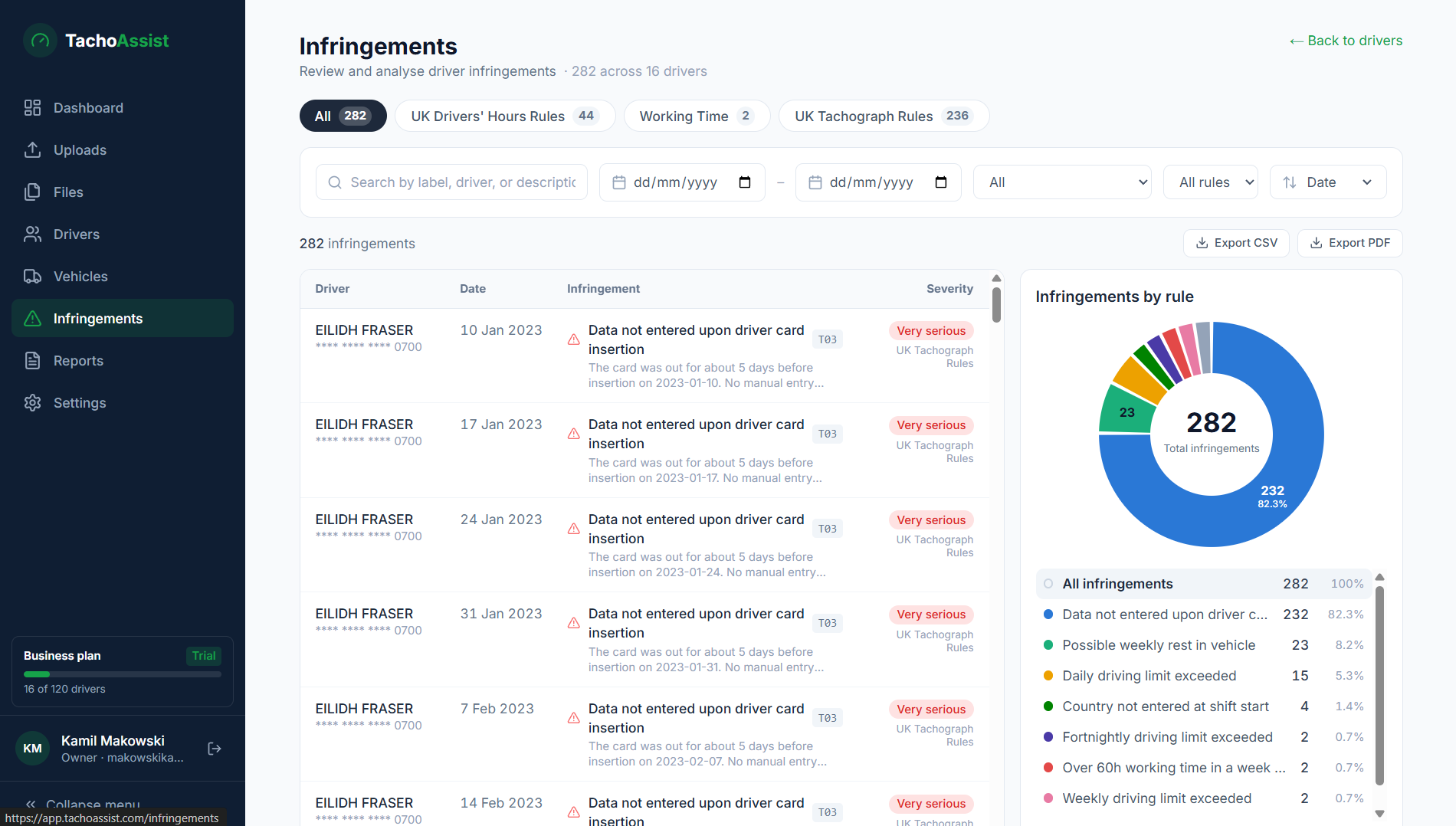
TachoAssist sells no hardware. The free TachoAssist Card Reader app turns any standard USB smart-card reader into a driver-card download tool on Windows or Android; vehicle unit data still comes from your download key or remote download. TachoAssist itself is the browser-based workspace for everything that happens once the file exists.
Important: automated infringements support compliance work and must be reviewed. TachoAssist is not legal advice or a definitive statement of compliance.
Official sources
Guidance and legislation can change. Use these primary sources rather than relying on an unsourced summary.
Questions
At least every 28 days. The duty sits in section 97E of the Transport Act 1968, inserted by the Passenger and Goods Vehicles (Recording Equipment) (Downloading and Retention of Data) Regulations 2008, and is repeated in DVSA guidance. Check the current official guidance for your operation and circumstances.
At least every 90 calendar days, plus additional downloads in specified circumstances such as before transferring control of the vehicle or where data may be lost. The figure was 56 days when the 2008 regulations were made; the Passenger and Goods Vehicles (Recording Equipment) (Downloading of Data) Regulations 2015 changed it to 90. Pages still quoting 56 days for the vehicle unit are out of date.
It depends on the journey. The current day plus the previous 28 calendar days is the position for GB domestic and AETR work. Since 21 April 2025, 56 days applies to carriage undertaken exclusively within the UK and EU area by UK or EU registered vehicles, under the Drivers’ Hours and Tachographs (Amendment and Modification) Regulations 2025 (SI 2025/402). If a vehicle does both kinds of work, plan for the longer period.
Yes. DVSA guidance states that operators must periodically download driver card and vehicle unit data and analyse the information to ensure the rules have been complied with. Downloading on its own does not discharge the duty.
Tachograph records must be available for at least 12 months. Working Time (WTD) records under the Road Transport (Working Time) Regulations 2005 must be kept for two years after the period they cover. These are separate obligations with separate periods.
Not under the assimilated rules: there is no opt-out from the 48-hour average working week for mobile workers in scope of the Road Transport (Working Time) Regulations 2005. Drivers working solely under GB domestic rules fall under the Working Time Regulations 1998 instead, where an opt-out from the 48-hour week does exist. Confirm which regime applies before relying on either.