Ongoing fleet compliance management

Tachograph compliance software for transport businesses

Work out who to debrief first, see what is due before it is late, and keep the evidence behind every compliance decision in one place — the file a DVSA visit or a public inquiry would ask for.

Compliance workflowEvidence connected

A clear path from source files to retained records

1
Upload the downloadsDriver card and vehicle unit (VU) files, singly or as a ZIP.
2
Review infringementsRule, severity, dates, measured values and source evidence.
3
Debrief in priority orderFleet risk and reminders decide where the afternoon goes.
4
Retain the recordReports and history, kept for the required period.

Manage the continuing work, not only the file.

Tachograph analysis software explains what is in driver card and vehicle unit (VU) data. Compliance management begins after that data is readable: deciding what needs attention, debriefing the driver, preparing the records and doing it all again when the next downloads land.

That loop is what an O-licence undertaking actually describes — that “the rules on drivers’ hours and tachographs are observed, and proper records are kept.” TachoAssist connects the tasks without presenting automated infringements as a final legal judgement. The operator remains responsible for the applicable rules, the context and the action.

A connected tachograph compliance workflow.

Each stage keeps a route back to the uploaded source and forward to the record needed for follow-up.

1. Bring in the downloads

Upload or import driver card and vehicle unit files — .ddd, .esm, .tgd, .c1b, .v1b, .a1b or a ZIP — and retain their file history.

2. Analyse activity and rules

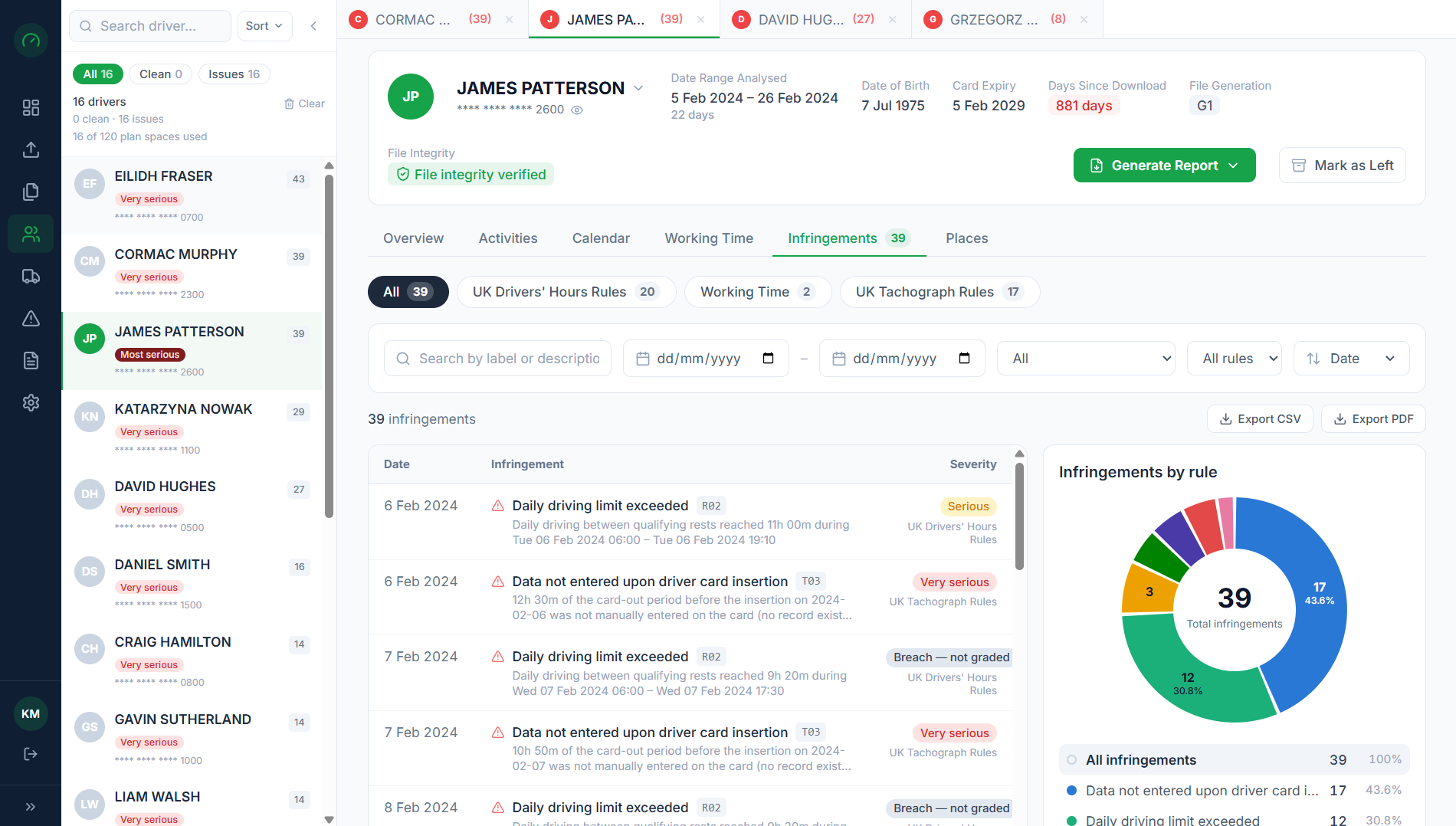
Review driver timelines, drivers’ hours, Working Time (WTD) and tachograph infringements in the rule set configured for your operation.

3. Prioritise and document

Use severity and risk to pick the drivers to debrief first, then prepare reports, reminders and unknown-period documentation.

Scope

What TachoAssist checks.

Set the operating country once. From there the checks, the Working Time mode and the fine estimates follow the jurisdiction — the UK and all 27 EU member states, 28 rule sets in total.

Driving time and breaks

Daily and weekly driving limits, the extended driving days, the fortnightly limit, the 4.5-hour break rule and split-break arrangements — under assimilated Regulation (EC) 561/2006.

Rest periods

Daily rest including reduced and split daily rest, weekly rest, reduced weekly rest and the ordering of compensation for it.

Working Time (WTD)

The 48-hour average week over the applicable reference period, the 60-hour single-week maximum, break rules for shifts over six and over nine hours, and night-work limits — under the Road Transport (Working Time) Regulations 2005.

Tachograph obligations

Card use, manual entries, unknown periods, missing data, card-in and card-out records and equipment events — under assimilated Regulation (EU) 165/2014.

Mobility Package

International driver identification, country entries and border crossings, the international derogation, weekly rest compensation ordering, rest taken on a ferry or train, and an optional advisory return-home check under Article 8(8a).

Domestic rule sets

Where GB domestic or another member state’s national rules apply instead, the corresponding limits, severity table and Working Time treatment are used rather than the assimilated ones.
One thing this page will not claim: the eight-week vehicle-return requirement annulled by the Court of Justice is not assessed, and a check is only as good as the records uploaded to it.

Post-Brexit scope

Assimilated rules or GB domestic rules?

Getting this wrong is the most common way a UK operator ends up checking the right data against the wrong limits. The vocabulary changed too: what used to be called “EU rules” for GB work is now, correctly, the assimilated rules.

  • Assimilated rules cover most in-scope goods vehicle work in Great Britain — the retained drivers’-hours and tachograph regulations, plus Working Time (WTD) under the Road Transport (Working Time) Regulations 2005.
  • GB domestic rules apply to a narrower set of work outside that scope, with different daily driving and duty limits, and with the Working Time Regulations 1998 in place of WTD.
  • The WTD opt-out trap. There is no opt-out from the 48-hour average under the assimilated regime. Only drivers working solely under GB domestic rules, who fall under the 1998 Regulations, have one available. Plenty of published guidance still gets this backwards.
  • Mixed operations are the norm rather than the exception, and a vehicle that does both in the same period is planning around the stricter figure.

See how this changes the roadside carry period too

Working Time (WTD) and tachograph infringements with severity, measured values and rule breakdown

Risk and follow-up

Find the drivers to debrief first.

Fleet totals hide the thing that matters. The driver with the most infringements is often not the one to see first; the driver whose severity is climbing is. An internal risk score per driver combines recency, repetition and severity into a working order for the afternoon — the panel is called “Drivers Needing Attention” in the app.

Prioritise

Rank by recent, repeated or higher-severity infringements rather than raw counts, over a rolling window anchored to each driver’s own data.

Investigate

Open the relevant dates, measured values, rule category, explanation and confirmed or potential status where provided.

Decide responsibly

The score is internal to TachoAssist, not an official authority rating and not an OCRS band. Use it to organise a human review, not as an automatic disciplinary or legal conclusion.

Keep repeating compliance tasks under control.

Download deadlines

Cards every 28 days, vehicle units every 90. Reminders arrive before the deadline rather than after it, alongside driver card expiry dates.

Scheduled Reports

Save driver or vehicle report settings and frequency, then generate the next output from its due reminder instead of rebuilding it.

History and retention

Return to report and file history, manage archived drivers and apply retention or deletion controls — against a 12-month tachograph and two-year WTD obligation.

Recurring evidence

Prepare the right report at the right interval.

Configure recurring driver or vehicle reports for all or selected subjects, choose an available format and set a weekly, multi-week or monthly frequency.

Save the setup

Keep the subjects, report type, format and frequency together for the next reporting cycle.

See when it is due

TachoAssist creates a dashboard reminder when the scheduled report needs attention.

Generate and advance

Download the report and move the schedule forward. The output is not automatically emailed.

Explore tachograph reports and Scheduled Reports

Unknown periods

Document missing activity without guessing the reason.

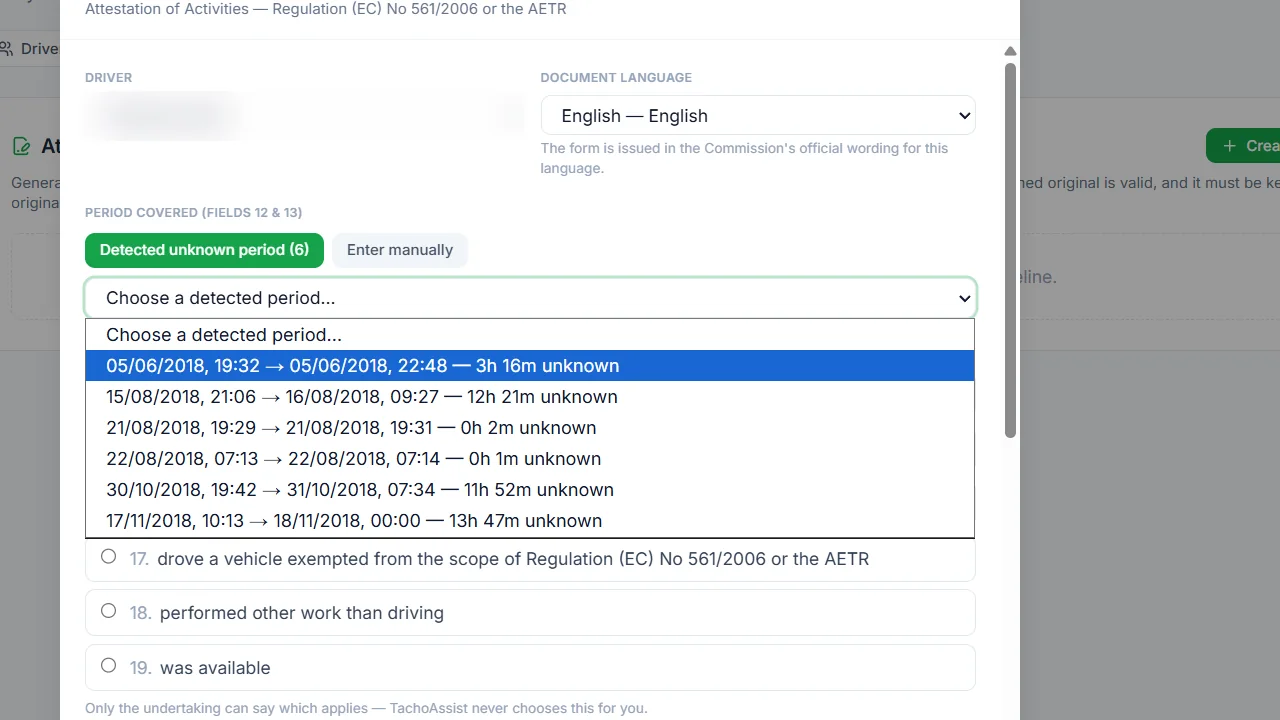
Automatic unknown-period detection finds gaps in the analysed driver record — time with neither a recorded activity nor a manual entry to account for it. The user or undertaking decides whether an official form is appropriate and selects the correct activity reason; TachoAssist does not label every gap as rest.

  • Detected period presented for review
  • Six official activity-reason choices
  • Available driver and undertaking details prefilled
  • Attestation of Activities output in 23 official-language templates

Review the EU tachograph attestation form workflow

Unknown tachograph activity period detected for attestation review

Questions

Tachograph compliance software FAQ

How is compliance software different from a .DDD file viewer?

A viewer opens individual records. TachoAssist also supports the continuing process a transport manager actually runs: prioritising driver risk, reviewing infringements, keeping download deadlines visible, preparing recurring reports and retaining the history behind each decision.

What is the difference between assimilated rules and GB domestic rules?

Assimilated rules are the retained EU drivers’-hours and tachograph rules that apply to most in-scope goods vehicle work in Great Britain, together with Working Time (WTD) under the Road Transport (Working Time) Regulations 2005. GB domestic rules apply to a narrower set of work outside that scope, with different daily driving and duty limits and the Working Time Regulations 1998 rather than WTD. Set the rule set on the workspace and the checks follow it.

Does TachoAssist guarantee tachograph compliance?

No. Automated infringements, risk indicators and EU fine estimates support a responsible review. They must be checked against source data, circumstances and the applicable rules.

Can it manage both driver and vehicle evidence?

Yes. Business workspaces support driver card and vehicle unit (VU) analysis plus driver, selected-driver, fleet and vehicle reports in PDF or Excel.

Can TachoAssist help document unknown periods?

Yes. It can detect unknown periods and prepare an official Attestation of Activities form after the user or undertaking chooses the correct reason when a form is appropriate. A gap is never assumed to be rest.

About 58p per driver per week

Build an ongoing fleet compliance workflow.

Start a 14-day Business trial — no payment card details needed, and no minimum term. Business is £2.50 per unique driver used per month after the trial. Prices are in GBP and no VAT is charged.